
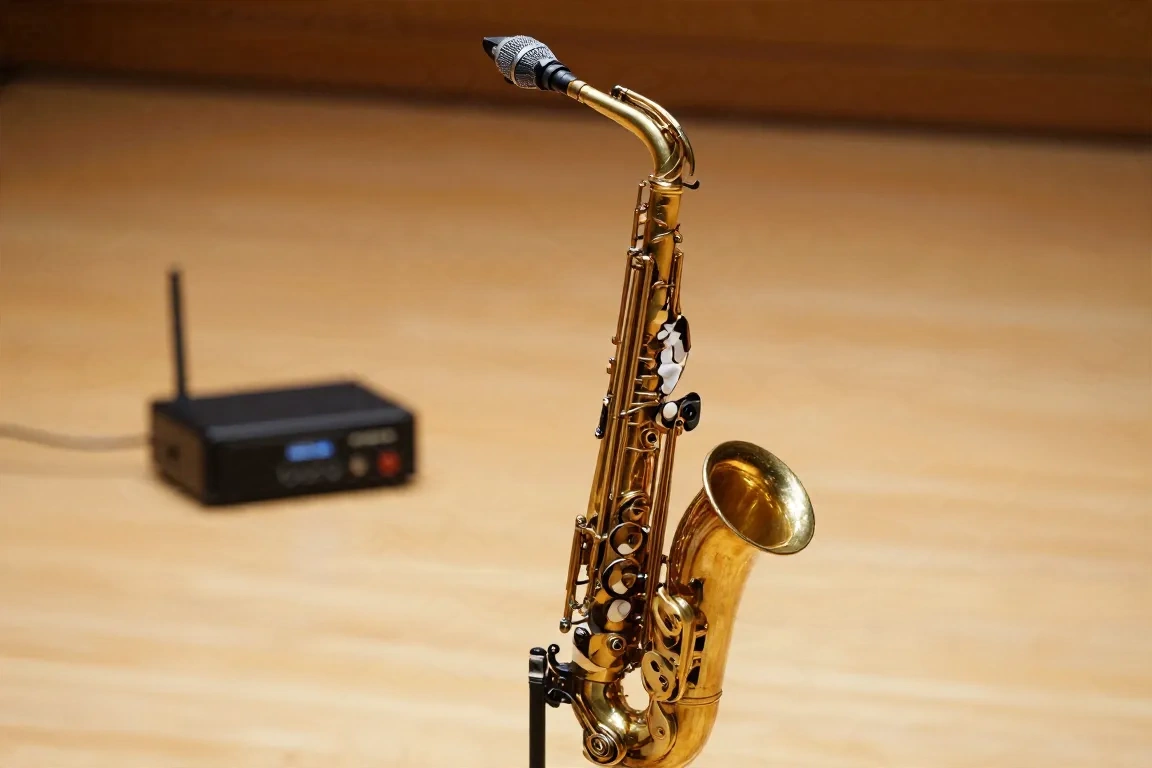
For a wireless microphone for saxophone, choose a stable clip, low-latency transmission and a capsule capable of capturing both the bell and the tone holes. For straightforward stage use, the NUX B-6 is the most direct choice; for an upgradeable setup, the Shure GLXD14+/B98 with Beta 98H/C offers a more modular signal chain.
The right model then depends on your saxophone, your mobility and the sound you are looking for. This guide compares integrated systems, beltpack transmitters, frequency bands and useful positioning options. To broaden your search, also see our guide to the best microphone for saxophone.
A clip designed for the bell does not automatically turn the saxophone into a simple source to amplify. The register, capsule angle, key noise and risk of feedback can all significantly change the result. You should therefore choose the architecture before comparing brands.
How to choose a wireless microphone for saxophone according to its use
For a concert where you move around a lot, choose a system with a dedicated clip and matching receiver. The cable connecting the capsule to a beltpack transmitter remains useful if you want to reduce the weight on the bell or replace the microphone later. For rehearsals or small performances, an integrated system is quicker to set up.
The NUX B-6 is designed for simplicity: its transmitter attaches directly to the microphone and its receiver picks up the signal without a cable between the saxophone and your belt. It operates at 2.4 GHz, claims latency below 4 ms and offers three EQ modes for soprano, alto and tenor.
For a more upgradeable signal chain, the Shure GLXD14+/B98 combines the Beta 98H/C, a GLXD1+ beltpack transmitter and a GLXD4+ receiver. The Sennheiser e 908 B ew is also suitable for a setup with an Evolution Wireless transmitter, provided you choose the system compatible with its connector.
| Solution | For whom | Strength | Limitation |
|---|---|---|---|
| Integrated system | Mobile performers | Quick setup | Weight on the bell |
| Microphone with bodypack | Upgradeable system | Replaceable microphone | Cable and pack to manage |
| Wired microphone | Studio or static stage | No RF battery | Reduced mobility |
| Remote microphone | Natural pickup | More open sound | Increased spill and feedback |
For a marching band or a musician who often changes position, prioritise stability and battery life over an exceptionally wide frequency response. For effects, focus on the receiver output and compatibility with your pedals. The best choice is the one that remains reliable throughout the entire set.
Microphone on the bell or beltpack transmitter: which architecture should you choose?
The integrated system
An integrated system combines the microphone, transmitter and sometimes the battery in a single unit attached to the bell. The NUX B-6 takes this approach with a gooseneck electret condenser microphone, a shock-absorbing clip and a charging case. This reduces the number of cables attached to your clothing.
This simplicity comes with a practical trade-off: some of the weight sits on the instrument. On a lightweight soprano, the balance may become more noticeable; on a tenor, the strain is often less perceptible, but the clip must remain correctly oriented. Charge the system before every performance and check the receiver’s battery level.
The beltpack transmitter system
With a Shure WB98H/C or Sennheiser e 908 B ew, the capsule stays on the bell while the transmitter is worn on the belt. The weight is better distributed, and the microphone can be replaced without changing the entire RF chain. This solution suits musicians who already own wireless equipment.
The Shure WB98H/C is designed for a beltpack transmitter with its mini 4-pin connector. Do not confuse it with the wired Beta 98H/C, supplied with an XLR cable and inline preamp. The GLXD14+/B98 kit includes the microphone and the corresponding RF components.
Before choosing a brand, first check the saxophone’s balance with the clip installed. A system that is slightly less compact but stable and comfortable will often deliver a better result than a transmitter that moves every time you do.
Which frequency band and latency are needed for delay-free playing?
Latency is the delay between the breath, the captured sound and its return through the PA system. For a live instrument, it must remain low enough not to interfere with the attack. The NUX B-6 claims less than 4 ms, a value suited to stage performance when it is installed correctly.
2.4 GHz systems are simple to use, but this band is also used by many networks and wireless devices. The Shure GLXD14+/B98 uses dual-band digital transmission at 2.4 and 5.8 GHz. This can help manage the link, but does not guarantee perfect reception in every venue.
UHF systems generally allow more structured frequency management in professional setups. However, you must check which frequencies are permitted and avoid conflicts with other RF systems. A manufacturer’s stated range remains theoretical: walls, audiences, antennas and receiver position all reduce it.
Position the receiver within line of sight wherever possible, away from radio sources and metal obstacles. Test it while walking through the area where you will perform. A stable link and low latency matter more than an isolated range figure printed on the specification sheet.
How to position the clip without marking the saxophone’s finish
A good clip has surfaces protected by soft rubber or a comparable material. Inspect them before every setup: hard dust or a displaced part can scratch the finish. The clip should hold without slipping, but it must not crush the bell.
Place it on a sufficiently rigid area, then angle the gooseneck without creating tension. The cable on a beltpack model should follow the instrument’s body with a little slack. Secure it without trapping it in the keys and allow the musician to move naturally.
On a soprano, alto or tenor
The soprano has a smaller bell and a playing position that can bring the capsule closer to the face. Use a lightweight clip and check that the gooseneck interferes neither with the hands nor with vision. The NUX B-6’s soprano mode is designed to tailor the EQ for this use.
The alto is the simplest case for a bell clip. The tenor requires more attention because of its weight and curvature: check that the transmitter does not pull on the microphone as you move. In every case, the bell must remain free to vibrate.
Attachment mistakes to avoid
- Tightening the clip until it compresses the metal or finish.
- Allowing the cable to rub against the keys during playing.
- Positioning the transmitter so that it pulls the bell to one side.
- Moving the clip without checking the capsule’s orientation.
Bell or body: which pickup gives a natural saxophone sound?
Aiming at the bell
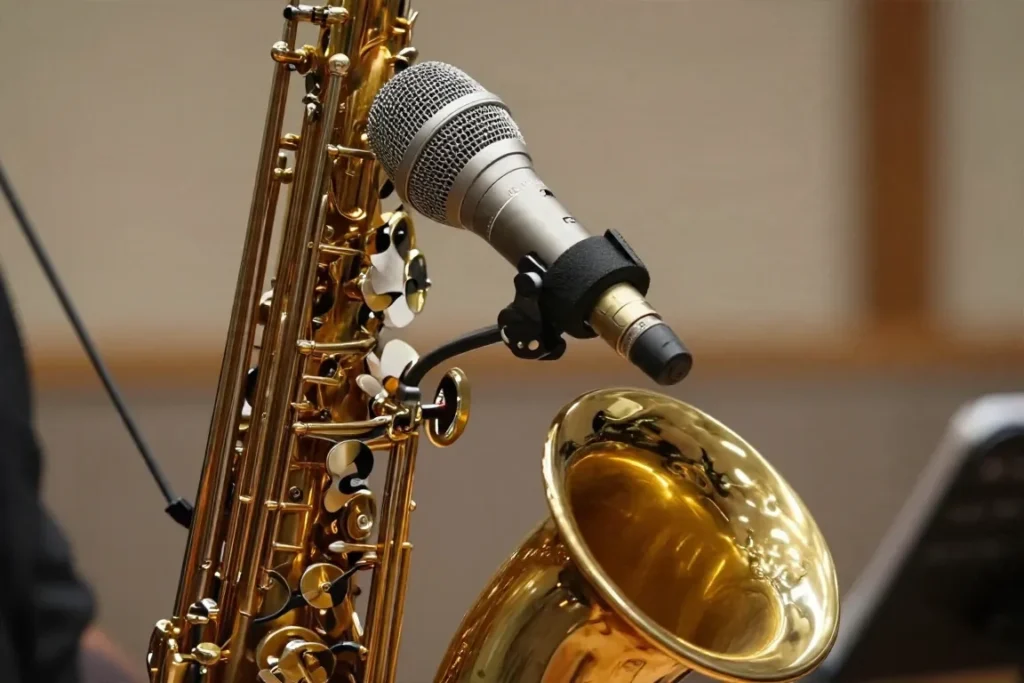
Pointing the capsule towards the bell often gives more attack, presence and brightness. The sound is direct and may resist stage noise better. This positioning works when the saxophone needs to cut through a dense group, but it can emphasise a harsh tone if the gain is too high.
Do not place the capsule directly against the opening. With a clip, even small adjustments to the gooseneck can change the balance between bass, mids and treble. Angle the capsule slightly off-axis if the sound becomes aggressive, then reduce the gain before raising the desk level.
Aiming at the tone holes
The open tone holes contribute strongly to the saxophone’s radiation, particularly in the upper register. A capsule aimed towards the body can therefore provide more warmth and a more natural impression. However, it also picks up key noise and the sounds of other instruments more easily.
The correct angle is not the same for every saxophone. Start with the capsule between the bell and the tone holes, then listen to low, middle and high notes. Adjust the positioning before EQ: positioning corrects an imbalance more effectively than extreme console adjustments.
A cardioid pattern mainly rejects sound from the rear of the capsule and helps limit spill from a speaker positioned behind the musician. A narrower pattern can isolate the source more effectively, but is also more sensitive to angle changes. The saxophone must remain within the capsule’s useful area.
Technical criteria to check before buying
An electret condenser capsule offers good sensitivity and reproduces the nuances of the performance. A cardioid capsule is generally a safe choice for the stage. Also check the maximum SPL, as the bell can produce a high level at close range. A response of 20 Hz to 20 kHz is not enough to predict the sound.
Examine the microphone connector, transmitter type and receiver output. A mini-jack intended for an Evolution Wireless system will not connect directly to every bodypack. A wired XLR model, such as the Beta 98H/C in its wired configuration, requires 11 to 52 V phantom power.
- Battery life: choose enough reserve for the concert length and plan to recharge.
- Latency: look for transmission designed for live performance.
- Attachment: check the clip’s protection and the gooseneck’s grip.
- Accessories: check that the receiver, cable, charger and case are included.
The NUX B-6 claims approximately four hours of battery life, a range of approximately 20 m and a response of 20 Hz to 20 kHz. The Shure GLXD14+/B98 claims up to 12 hours of use. These figures help compare solutions, but temperature, volume and radio conditions affect real-world use.
Which wireless microphone should you choose for soprano, alto and tenor?
For an alto used in concert, the NUX B-6 is the simplest choice: the clip, transmitter and receiver form a coherent system, with a dedicated alto EQ mode. Choose it if you want to play without adding a separate bodypack and if approximately four hours of battery life covers your performance.
For a tenor, choose the NUX B-6 if you prioritise speed and mobility. If you already have Shure equipment or want to be able to change the capsule and transmitter, the GLXD14+/B98 is more suitable. Its beltpack transmitter moves the weight away from the instrument, and its stated battery life provides more reserve.
For a soprano, pay particular attention to the clip’s size and the microphone’s proximity to the face. The NUX B-6 offers a soprano mode, while a modular system such as the Sennheiser e 908 B ew can integrate with a suitable Evolution Wireless setup. Do not choose solely according to the frequency band.
If you want reliable stage sound without frequently changing your setup, choose the NUX B-6. If you are equipping several instruments or want to expand your RF system, choose the Shure GLXD14+/B98 with the Beta 98H/C. The Sennheiser is a coherent option if you already own compatible transmitters.
Setup, adjustment and checks before going on stage
Start by charging the microphone, transmitter and receiver. Fit the clip to a clean surface, connect the receiver to the mixing console or amplifier, then pair the units according to the manufacturer’s procedure. Keep the headphone volume at a reasonable level during checks.
- Position the capsule between the bell and the tone holes.
- Set the gain low enough to prevent clipping.
- Play slowly in the low, middle and high registers.
- Move around to identify dropouts and feedback zones.
Listen for key noise before adjusting the EQ. If it becomes too prominent, move the capsule slightly away from the tone holes or alter its angle. If the sound lacks attack, gradually move it closer to the bell rather than abruptly boosting the treble.
Feedback often occurs when the speaker sends its energy directly towards the capsule. Aim monitors away from the microphone’s axis, lower the gain and find the problem frequency with the help of the console. Never compensate for poor attachment with a higher level: this increases the risk of whistling and clipping.
Before connecting or disconnecting an XLR microphone, switch off phantom power. It is required by some wired microphones, but must not be sent indiscriminately to a wireless system. Then secure the cable and bodypack so that nothing catches during movement.
FAQ: wireless microphone for saxophone
What is the best wireless microphone for alto saxophone?
The NUX B-6 is the simplest choice for an alto saxophone played on stage. Its clip, integrated transmitter, alto mode and receiver form an easy-to-install system. The Shure GLXD14+/B98 is preferable if you need a modular setup or longer stated battery life.
Can you use a wireless microphone for saxophone in a home studio?
Yes, but a wireless microphone is not automatically the best choice for a home studio. It adds a radio link and a battery when a cable may be sufficient. Use it if you need to move during recording; otherwise, a well-positioned wired microphone provides a simpler signal chain and avoids recharging.
Does a wireless saxophone microphone work with an effects pedal?
Yes, if the receiver output and pedal input use compatible levels and connectors. Connect the receiver to the pedal, then the pedal to the console or amplifier. Check the gain to avoid overloading the input, especially with distortion or compression effects.
What is the difference between a UHF RF microphone and a 2.4 GHz system?
A UHF system uses a band that is often managed with more coordination between frequencies. A 2.4 GHz system is generally simple to deploy, but shares the band with other wireless devices. Stability always depends on the venue, obstacles, receiver and networks present.
Should you choose a cardioid or supercardioid capsule for saxophone?
A cardioid capsule is the safest choice to begin with, as it rejects the rear and tolerates small changes in angle. A supercardioid can isolate the saxophone more effectively, but requires more precise positioning. Choose it only if the stage and monitor positions are well controlled.
Is the NUX B-6 also suitable for soprano and tenor?
Yes, the NUX B-6 offers EQ modes for soprano, alto and tenor. However, its clip must remain stable on each instrument, and the gooseneck’s orientation must be adjusted. Pay particular attention to the soprano’s balance and to cable or transmitter tension on the tenor.
Which instrument microphone should you choose if you do not want a wireless system?
Choose a wired clip-on microphone if you play seated, in the studio or close to your amplifier. The Shure Beta 98H/C is a saxophone-specific solution with an XLR cable and phantom power. You lose freedom of movement, but avoid batteries, radio interference and pairing.