
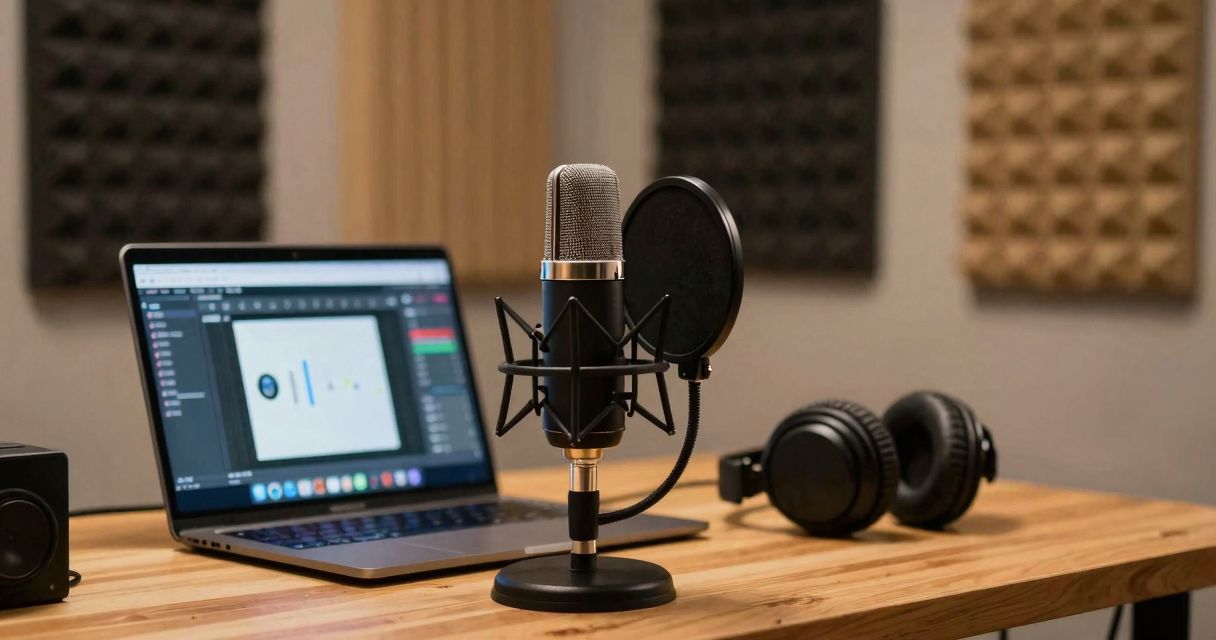
A USB mic that sounds “pro” without a mixer or preamp, that's the promise of the AUNA MIC-920B. I spent several days using it for voiceover, streaming and on singing/speech demos, in a roughly treated office and then in a more reverberant room. On the menu of this test and review: sound rendering, ergonomics, useful settings, limits to know and putting it in perspective against consumer references. Clear objective for the busy internet user: to know in a few minutes whether this micro USB has a place in your home-studio or content creation setup.
What the AUNA MIC-920B reveals as soon as you pick it up
Metal chassis, dense grille, reassuring weight: this is far from a gadget. The standard-format condenser capsule works in cardioid directivity, designed to isolate the voice located in front of the microphone head. Commercial versions vary on accessories: you commonly encounter a pop filter, elastic suspension, tripod or arm, depending on the pack chosen. In terms of connections, the core target remains USB (Plug & Play on Mac/Windows), some variants offering an additional XLR output for a dedicated audio interface.
On paper, the resolution and sampling rate announced stay within consumer standards (up to 16 bits/48 kHz depending on the bundles). No software gimmicks invading the interface: the essential is in the capsule and the ease of use. This is exactly what content creators are looking for who want to plug in, set the gain staging and record.
Test protocol and usage context
To judge the performance, I recorded spoken excerpts at 15 cm from the mic with and without plosive reduction (filter), then a projected text at 25 cm. I also captured an acoustic guitar at 30 cm in position 12th fret, and a close whisper to simulate simple ASMR takes. The sessions were done in Reaper and Audition, without processing at first, then with a light dynamic processing (soft gate + compressor at 2:1) to assess the margin.
Two spaces: a desk equipped with a rug and thick curtains, and a livelier room (tiled floor, bare walls) to see how forgiving the mic is of acoustics. I finally compared excerpts with a Yeti and a NT‑USB to gauge the 920B's personality.
Sound reproduction: timbre, details and noise control
On spoken voice, the 920B delivers a neutral color with a kept low end, a clear midrange and a discreet high end. The sibilance of the “s” remains measured, no shrill accent: good point for hours of podcasting. Proximity pleasantly reinforces warmth without getting muddy if you keep 10–12 cm and a filter. The background noise perceived is contained: in a quiet room, the breath stays low and is masked as soon as you place the voice correctly.
On acoustic guitar, the attacks come out cleanly. The upper harmonics are less bright than with some studio XLR condensers; this is logical given the USB positioning. For demos, voice/guitar covers or streaming showcases, the result remains very usable, especially with a touch of gentle EQ around 8–10 kHz.
In an under-treated environment, cardioid limits the ambiance but doesn't work miracles: reflections remain audible if you move away. A rug under the desk, a blanket behind the speaker and you're set to keep a clean sound capture.
AUNA MIC-920B vs. popular alternatives
To give you a quick frame of reference, I placed the 920B side-by-side with two consumer giants. The Yeti, often cited, offers multiple directivities, while the NT‑USB leans toward simplicity and clear vocal clarity. The 920B positions itself as an effective and more affordable option, with a calm sonic signature and a convincing feature-to-price ratio.
| Model | Connection | Directivity | Vocal personality | Intended use |
|---|---|---|---|---|
| AUNA MIC-920B | USB (some versions with XLR) | Cardioid | Neutral, soft in the highs, warmth when close | Podcast, voice-over, solo streaming, voice/guitar demos |
| Blue Yeti | USB | Cardioid, omni, bidirectional, stereo | More present in the high-mid | Multi-setup, two-person video calls, varied content |
| RØDE NT‑USB | USB | Cardioid | Clear, defined highs | Challenging spoken voice, pop singing, polished narration |
If you’re wavering about the Yeti for its multiple polar patterns, the interest materializes mainly in duo or table-talk setups. In solo, the cardioid of the 920B will be enough. For a look at the limits of a more entry-level mic, see our Blue Snowball test. And for a direct voice-oriented competitor, take a look at the RØDE NT‑USB.
Installation, software and first useful settings
Plug in, select the device in your DAW or videoconferencing tool, set the level to hit -12 dBFS on vocal peaks. Once this “sweet spot” is set, add a high-pass around 80–100 Hz if needed to chase away the rumble. A light 2:1 compressor smooths the swings without pumping. If your pack includes a shock mount, install it: it reduces noises transmitted through the desk.
- Distance mouth/mic: 10–15 cm + pop filter to control the “p” and “b” sounds.
- Angle: 20–30° off-axis to reduce the plosive reduction and sibilance.
- Position: above the mouth, slightly angled down toward the chin to avoid direct breath.
- Room: heavy curtains behind you, rug under the desk; clear gains in perceived cleanliness.
For live use, set a very light gate only if your environment is noisy; too tight, it will “eat” the ends of words. A gentle de-esser can reassure sibilant voices, but the 920B already handles natural sibilance well.
Podcasting, streaming, light singing: who is this mic for?
The 920B ticks the boxes for beginner-to-intermediate podcasters, solo streamers, and online instructors. The spoken word comes out legible and comfortable to listen to, which minimizes listener fatigue. For sung demos or chant/speak readings, it delivers a clean result right from the take, which you can polish with a soft EQ. For a face-to-face duo, a second mic is better than widening the distance and opening up the acoustics.
Nomad creators will appreciate packs with a carrying bag: the suspension protects against shocks, and the table tripod comes in handy on a training shoot. Mono ASMR enthusiasts will get detailed whispers, provided you stay close to the capsule and take care of the environment.
Audio engineering tips to elevate the AUNA MIC-920B
- Keep the system input around 50–70% and finalize the gain in the software to avoid digital clipping.
- Use a gentle high-pass on vocal tracks to clear the lower end without making them thin.
- Add a short room-type reverb as needed; better a controlled room than a reverberation that is too present.
- Presence EQ: +1 to +2 dB around 3–4 kHz is often enough to cut through in a mix.
- Mechanical stability: a quality articulated arm limits desk-borne noises better than a small desk stand.
These micro-adjustments transform a good recording into a finished result, without expensive plugins or a complicated setup.
Strengths, limitations and verdict, no-nonsense
- What we like: natural vocal rendering, quick editing, complete packs, effective accessories, solid value for money.
- To know: sensitivity to bright acoustics if you move away, no built-in software gimmicks (which will please those who want simple, but will frustrate fans of native effects).
My verdict after this test: the AUNA MIC-920B delivers exactly what one expects from a serious USB mic: a healthy sonic base, few surprises, and the margin needed to build a coherent voice signature. To outfit a speech studio, launch a podcast or stabilize a clean live stream, it’s a safe and rational option.
If you’re looking for other references before deciding, compare the excerpts with the RØDE NT‑USB or the Blue Snowball to refine your choice based on your timbre and uses.
Purchase scenarios and practical recommendations
Are you starting in vocal production and want a clean setup? The USB pack + filter + stand is enough. Are you planning to upgrade to an audio interface? Aim for a bundle with XLR to keep an output ready to migrate. Working with closed-back headphones, placing the mic in the right spot, and mastering the local acoustics often brings more than changing equipment. This progressive approach guarantees consistent results, session after session.
For shared studios, think about marking the ideal position of the arm and the filter on your desk. A few Scotch markers, and you’ll find your aiming angle in 30 seconds, with the same level from session to session.
Overall verdict
The AUNA MIC-920B stands as a reliable tool for those who want a clear voice, a simple workflow and useful accessories right out of the box. It is not intended to imitate a high-end large-diaphragm mic connected to a vintage preamp; it focuses on consistency and ease. Mission accomplished. In the hands of someone who tunes their room and their settings, it becomes a discreet, steady partner ready to publish without excessive retouching.
If you’re looking for other references before deciding, compare the excerpts with the RØDE NT‑USB or the Blue Snowball to refine your choice based on your timbre and uses.