
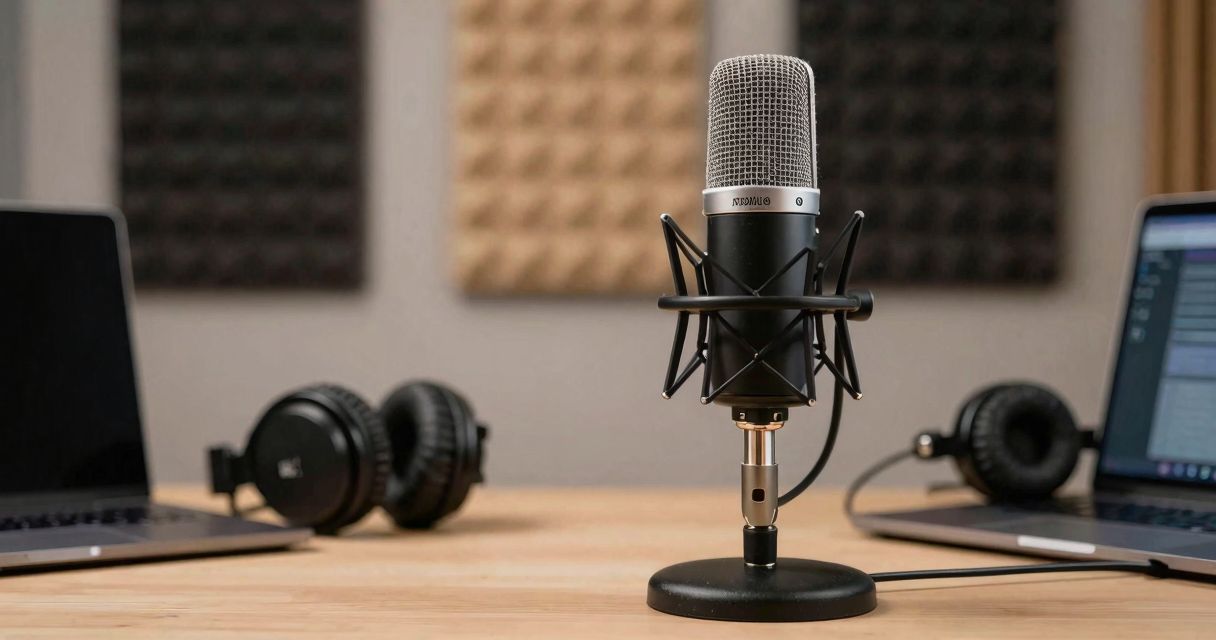
The Audio-Technica AT2020USB+ is aimed at those who want a clean recording without getting lost in the gear. This USB microphone carries the brand's studio DNA and opens it to creators, podcasters and musicians seeking a reliable, simple and effective tool. After several test sessions — voice-over, acoustic guitar, live on Discord — here is a candid report, designed to help you decide with complete confidence.
AT2020USB+ in-field test: what we expect, what we get
The AT2020USB+ isn't a gadget variant. It features a condenser capsule inherited from the AT2020, a cardioid polar pattern that frames the source, and a clear sound in the upper part of the spectrum. The major appeal lies in the balance between simplicity and control: USB connection, gain adjustment by ear, and stability that reassures during long takes.
In calm narration, the voice gains proximity without excessive sibilance. On a folk guitar, the articulation of transients remains clear at short distance. For streaming, the timbre retains body even at low room volume, provided you manage plosives with a pop filter.
Build and ergonomics: a tool that can weather the road
Metal chassis, dense grille, serious finish. The AT2020USB+ exudes durability. The handling is immediate: a single headphone volume knob, a blend wheel to dose direct return and computer audio, and a standard thread. The desk stand included is handy to start, but an articulating arm significantly improves ergonomics and reduces handling noise.
The bundle contains the essentials to record right out of the box: a pivoting stand, tripod, USB cable. No frills, only what is actually useful.
Connection and settings: plug-and-play without stress
Instantly recognized by macOS and Windows, no proprietary driver is required. The AT2020USB+ operates at 16-bit / 44.1–48 kHz sampling. For a voice-over, place the mic at 15–20 cm, blend in some monitoring via the knob, then adjust the software gain to target peaks around -12 dBFS. This margin avoids clipping while keeping density.
In DAWs (Reaper, Logic, Audition), a light high-pass at 80 Hz cleans up rumbles. A gentle compressor (ratio 2:1) is often enough to stabilize dynamics without flattening the performance.
Sound quality: voices, singing and instruments under scrutiny
The signature is straight, fairly bright, with good consonant intelligibility. The lows stay controlled, useful for radiophonic voices without veering into boomy. You perceive a wide frequency response that supports diction and places the artist well in the mix.
Speech and voice-over
The grain remains natural, close to what an XLR version would deliver via a good preamp. The perceived breath depends mainly on the room and the gain, not on the microphone itself. A moderate de-esser is enough to tame the “s” sounds.
Singing
Good headroom for pop/folk voices. The proximity effect helps finer timbres. For very powerful singers, keep a bit of distance and steer the microphone off-axis by a few degrees.
Instruments
On acoustic guitar, you get a precise attack near the 12th fret. Digital pianos and synths come through without troublesome coloration. For light percussion or handpan, move away 30 to 40 cm for a more natural field.
Headphone monitoring: mastering your performance in real time
The built-in 3.5 mm headphone jack and latency-free monitoring change the game in solo recording. You adjust the mic return and the computer audio via the direct mix control, which prevents singing from “the void.” In practice, you quickly set the level to hear just enough to deliver a more confident take.
Competition: two USB alternatives to watch closely
To assess positioning, we compared with two accessible references. The AT2020USB+ preserves the edge in the finesse of the highs and the sense of depth, while remaining very easy to use.
- Auna MIC 920B: rounder, a little less detailed in the upper-mid, dedicated software as a bonus. Full comparison here: test Auna MIC 920B.
- Fifine USB gaming: versatile and affordable, noticeable presence, ideal for chat and live. Read: test of the Fifine USB microphone.
The AT2020USB+ stands out with a solid quality-for-money ratio for a “studio-like” voice ready to mix, without heavy post-processing.
Who is it really for?
Video creators, narrators, solo musicians, online instructors. If you need a clear and consistent voice, it's a reliable ally. Streamers will gain a more professional sound than most built-in mics, with precise return control to avoid surprises on air.
- First steps in a home studio without an interface.
- Spoken voice: e-learning, documentary, audiobook.
- Podcast and two-mic roundtable, each on a separate USB port.
- Streaming regularly with a compact setup.
Recording and room acoustics tips: the little extra that makes all the difference
A microphone reveals the room. Even discreet treatment — thick curtains, rug, bookshelf in the background — reduces resonances and gives a more pro sound. Position the mic slightly above the mouth, tilted downward, to limit plosives. Keep 15–20 cm with a pop filter and think about gain: it's better to record a bit quieter and raise in the mix than the opposite.
- Move away from keyboards and desks to reduce structural noises.
- Use a boom arm and elastic suspension if you type on the keyboard.
- Enable a high-pass filter in the DAW to clean up parasitic lows.
- Limit compression during recording; refine during mixing.
Strengths and limitations noted during the test
- What we like: clarity, presence, consistency across different voices, simplicity of monitoring, very clean results for voice-overs ready to deliver.
- To note: sensitivity to plosives at close distance — the pop filter becomes almost indispensable; the included tripod transmits noises if the desk vibrates.
- What other solutions do differently: some USB mics offer software effects; here, we rely on raw capture, higher quality, to process later.
Essential technical sheet
| Transducer type | Condenser, electret, large capsule optimized for voice |
| Directivity | Cardioid (front-facing sound pickup, rear rejection) |
| Conversion | 16-bit / 44.1–48 kHz sampling |
| Frequency response | Wide band, suited for voice and instruments |
| Connectivity | USB for audio + 3.5 mm headphone jack with volume |
| Controls | Headphone volume, direct mix control (mic/PC) |
| Accessories | Pivoting stand, desk stand, USB cable |
| Compatibility | macOS, Windows, DAW software, live platforms |
Real-world microphone cases: how it performed for us
Reading a chapter of an audiobook, semi-treated room: 25 minutes straight with no dropouts, breath inaudible in the mix. Folk guitar + live voice on OBS: quick blend adjustment to keep a natural return and avoid pushing the voice. Teams meeting: intelligibility higher than computer mics, reduced listening fatigue for participants.
Consistency is the watchword: you plug in, place, record, and keep your studio habits, without piling up gear.
The verdict of the test bench: a reassuring standard for voice
The AT2020USB+ achieves what one expects from a serious USB microphone: a clean, faithful sound base, easy to use, with the comfort of precise headphone monitoring. It checks the essential boxes for producing regular content and fits into a light workflow.
If you record often, if you want to avoid a complexity factory and deliver clean tracks, it's a safe choice. To go further later, nothing prevents adding a boom arm, a suspension, and gentle room treatment to cross another milestone.
Key takeaways in one minute
- Clear and controlled signature, well suited for voice.
- Direct setup, latency-free monitoring well thought out.
- Simple progression path: boom arm + pop filter + a bit of acoustics.
- Excellent value for money for serious productions.