

To speak in front of a class, a group of visitors or athletes, choose a portable voice amplifier with a headset microphone, adjustable volume and rechargeable battery. A lightweight model is enough for a small, quiet room; for outdoor use or a noisy environment, choose more headroom and pay particular attention to microphone positioning, the risk of feedback and actual battery life.
The right choice depends less on an advertised wattage than on the distance to the audience, background noise and your mobility. Here is a practical method for choosing, setting up and adjusting your voice amplifier without confusing it with a hearing aid or a singing amplifier.
If you are undecided between an integrated system and a separate transmitter, also see the criteria for a wireless lavalier microphone. The same questions about range, attachment and battery life apply.
What is a portable voice amplifier for?
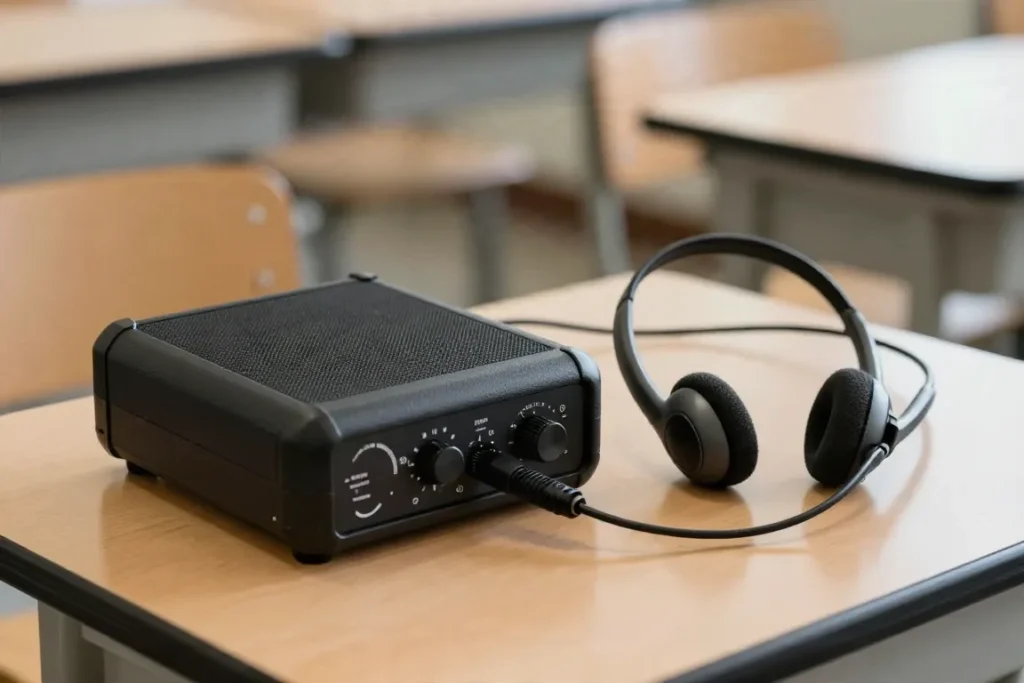
A portable voice amplifier combines a microphone, loudspeaker and self-contained unit. It increases the volume of your speech so that people at a distance can understand you without making you strain your voice.
It is suitable for teachers, guides, sports coaches, presenters or trainers who move around. The microphone captures your voice and the unit reproduces it immediately. You can speak normally rather than shout, making a long session more comfortable.
A voice amplifier does not replace a hearing aid. It acts on the voice of the person speaking, not directly on the audience’s hearing. Nor does it correct articulation, mouth noises or breathing picked up by the microphone.
A throat microphone is intended for a more specific use. It captures the vibrations of the larynx through contact with the throat and can help someone who speaks very quietly or whispers. Its sound nevertheless requires testing: it can also bring out mouth noises and articulation issues.
Which voice amplifier should you choose for the venue and audience?
Start by looking at the room and the distance between you and the back row. A quiet, absorbent room needs less level than a reverberant sports hall or a park exposed to the wind. The volume should remain intelligible without making the speech sound harsh.
| Solution | Suitable for | Strength | Limitation |
|---|---|---|---|
| Lightweight wired | Teacher, small room | Simple and reliable | Cable to manage |
| Compact wireless | Guide, mobile presenter | Freedom of movement | Charging and pairing |
| More powerful model | Coach, outdoor use | Extra level headroom | Bulkier unit |
| Portable PA speaker | Large group, large room | Wider coverage | Less discreet to carry |
For a classroom or small meeting
In a quiet classroom, prioritise a lightweight unit, an easily accessible volume control and a headset microphone. You do not need a very powerful system if the audience remains close and the walls do not create strong reverberation.
A wired voice amplifier is often the most sensible choice for this use. It avoids pairing and reduces the number of items that need charging. A model such as the MONACOR WAP-5 uses an electret headset microphone and a 3.5 mm line input, covering the usual needs of a lesson or lecture.
For a sports coach or outdoor guide
Outdoors, wind, conversations and distance absorb part of your voice. Choose a unit with plenty of level headroom, a secure attachment and a suitable windscreen for the microphone. Protection against splashes must be confirmed for the chosen model and never assumed.
Mobility then becomes the priority. A wireless microphone prevents the cable from pulling when you walk, show a route or lead an exercise. However, check the transmitter and unit’s battery life before every session.
When to move up to a portable PA speaker
A belt-worn amplifier reaches its limits in a large room, a very noisy sports hall or in front of a large audience. The small loudspeaker then has to work harder, increasing the risk of distortion and feedback.
Move to a portable PA speaker when the audience is far away or spread across a wide area. You will gain broader coverage and more controls, but you will be carrying a system that is less discreet than a compact voice amplifier.
Headset, lavalier or throat microphone: which should you choose?
The microphone should remain close to your mouth at a consistent distance. This stability lets you speak while walking, turning your head or bending down without major changes in volume.
Why a headset microphone is generally the best choice
A headset microphone, also called a headworn microphone, stays close to your mouth thanks to its frame. It follows your movements and leaves your hands free. For public speaking, it is generally the best choice when comfort and consistent level matter more than discretion.
Position the capsule slightly to the side of your mouth rather than directly in front of your lips. This reduces breath noise and plosives. A windscreen also limits the effects of wind, but it cannot fix a microphone positioned too far away.
When to choose a lavalier microphone
A lavalier microphone clips to a collar, jacket or item of clothing. It is discreet and practical when wearing a headset is inconvenient. Its distance from your mouth does vary, however, when you turn your head or your clothing moves.
Attach it near the top of your chest, without hiding it beneath a scarf or thick fabric. Avoid jewellery and zips that rub against the capsule. For a very mobile guide, a headset remains more consistent.
Who is a throat microphone for?
A throat microphone is mainly intended for people whose voice is very quiet, whispered or difficult to capture with a conventional microphone. It is worn against the throat and transmits the vibrations produced by the larynx.
Do not choose a throat microphone solely to obtain a louder voice. Its sound may be less natural and may amplify mouth noises or breathing. A trial is essential, with settings suited to the user’s actual requirements.
Wired or wireless: which system is most reliable?
A wired system connects the microphone directly to the unit. It starts quickly, requires no pairing and avoids an additional battery. Its practical drawback is that the cable can catch on a handle, item of clothing or sports equipment.
For a teacher who stays near their desk, wired is often the most reliable choice. It reduces potential causes of failure and simplifies microphone replacement if the plug or cable becomes faulty.
Wireless provides genuine freedom of movement, but adds a transmitter, receiver and batteries to monitor. Before an event, check the charge, connection and channel in use. Without a spare battery, mobility can turn into a failure halfway through a session.
So do not choose wireless as a matter of principle. Choose it when you need to walk, demonstrate a movement or guide a group on the move. For a static presentation, wired is simpler and often safer.
Power, battery life and weight: technical criteria to check
RMS power is more useful for comparing systems than peak power, which is often highlighted in product specifications. It does not provide a universal range, however: loudspeaker efficiency, room acoustics and noise matter just as much.
Also look at the frequency response. For speech, a bandwidth centred on the frequencies useful to the voice is sufficient. A very wide response does not guarantee better intelligibility, especially if it reproduces more background noise.
How many watts do you need for public speaking?
In a small, quiet room, a few watts may be enough if the unit is positioned correctly and the audience remains close. In a sports hall, street or park, you need more headroom to keep the voice clear without turning the volume fully up.
Never choose on wattage alone. Compare RMS power, the stated sound pressure level, loudspeaker size and intended use. A powerful unit in the wrong position may perform less well than a more modest model installed correctly.
What battery life is needed for a working day?
Advertised battery life depends on volume, battery condition, wireless operation and any Bluetooth playback. Allow some margin beyond the length of your presentation and check how long the system takes to recharge.
The MONACOR WAP-8 claims up to 20 hours of battery life according to the manufacturer’s specifications, with a rechargeable lithium-polymer battery. This figure remains an indication: sound level and the functions used can reduce actual battery life.
How much weight can you carry all day?
Include the unit, microphone, optional transmitter, battery and strap in your calculation. A 288 g voice amplifier such as the MONACOR WAP-8 remains light on paper, but comfort also depends on the attachment and weight distribution.
For a day of teaching, choose a unit that does not pull on your clothing. For sports activities, a stable strap and accessible controls are more valuable than a more powerful model that is difficult to wear.

How can you prevent feedback with a voice amplifier?
Feedback, or acoustic howl-round, occurs when the microphone picks up the sound produced by the loudspeaker. The signal loops, grows and turns into a whistle. The phenomenon depends on distance, orientation and volume.
Positioning mistakes that cause whistling
Never point the microphone towards the loudspeaker. Place the unit on your hip or behind you, with the loudspeaker facing the audience. Also avoid holding the unit close to your face: the sound then returns directly to the capsule.
With a headset microphone, keep the capsule near the corner of your mouth. With a lavalier, keep the unit away from the collar and surfaces that reflect sound. A nearby wall or pane of glass can also encourage feedback.
The right setting before you speak
Switch on the system with the volume low, then speak normally. Increase it gradually until the back row can understand you. If whistling appears, lower the volume immediately and correct the orientation before continuing.
The most effective feedback-prevention adjustment is often simple: move the microphone closer to your mouth, move the loudspeaker away from the microphone and lower the volume slightly. Do not compensate for poor positioning by increasing the level.
Voice amplifier or singing amplifier?
A voice amplifier prioritises intelligibility, simplicity and mobility. It should make words understandable from a unit worn on a belt or strap. Its controls are generally limited because speech does not require the same treatment as a musical performance.
A singing amplifier or PA speaker generally offers more power, bandwidth and inputs. It may accept several microphones, a music source and more precise controls. It is better suited to singing, music and large rooms.
For singing, choose a PA system or singing amplifier. A compact voice amplifier may work for a short performance, but it may lack headroom, low end and control over the singing voice.
Conversely, a singing speaker may be unnecessarily heavy for a teacher who simply wants to be heard during a lesson. The best voice amplifier is the one that meets the need for speech without making you carry an oversized setup.
Our choice for each type of user
For a teacher or trainer speaking in a quiet room, choose a lightweight wired voice amplifier with a headset microphone and a rechargeable battery or easily replaceable batteries. Simple start-up matters more than high power.
For a guide or mobile presenter, choose a wireless system if your movements require it. Check microphone stability, transmitter charging and the ability to adjust the volume quickly. A compact model such as the MONACOR WAP-8 follows this mobility-focused approach with its headset microphone, rechargeable battery and strap.
For a sports coach, park or noisy street, choose a unit with greater level headroom and a secure attachment. Protection against splashes should be clearly stated in the model’s specifications. A portable speaker is preferable if the group is large or very far away.
Reserve the throat microphone for specific vocal situations after testing. For most public-speaking situations, the clear choice is a headset microphone close to the mouth, paired with a lightweight, correctly positioned unit.
FAQ: voice amplifier
What is a voice amplifier used for?
A voice amplifier increases the volume of speech so that it can be understood by a group. It combines a microphone, loudspeaker and self-contained unit. It is suitable for teachers, guides, coaches and presenters, but replaces neither a hearing aid nor a concert speaker.
What device amplifies the voice?
The most suitable device is a portable voice amplifier with a headset microphone and adjustable volume. The headset maintains a consistent distance from the mouth, stabilising the level when you walk or turn your head. For a large room, choose a portable PA speaker instead.
Can you use a voice amplifier with a lavalier microphone?
Yes, if the amplifier has an input compatible with the lavalier microphone. Attach the capsule near the top of the chest, away from clothing noise. The result is discreet, but the level varies more when you turn your head. A headset microphone remains more consistent for a mobile speaker.
Does a voice amplifier work without mains power?
Yes, most portable models run on a rechargeable battery, batteries or rechargeable cells, depending on their design. Check the stated battery life and allow some margin. High volume, Bluetooth and battery age can reduce the runtime achieved in practice.
Why is my voice amplifier whistling?
It whistles because the microphone is picking up the loudspeaker’s sound, creating an acoustic loop. Move the unit away from the microphone, turn the loudspeaker towards the audience and place the capsule near the corner of your mouth. Then lower the volume before increasing it gradually.
Is a throat microphone suitable for someone who speaks very quietly?
A throat microphone may suit someone who whispers or produces a very quiet voice because it captures vibrations from the larynx. It does not automatically make the voice natural or clearer. Testing is needed to check comfort, intelligibility and any mouth noises.
Can you connect a phone or tablet to a voice amplifier?
Yes, if the model has a line input, Bluetooth or another compatible input. The phone can then play a backing track or audio content, but this uses more power. For simple speech, disable unnecessary functions to preserve battery life.