
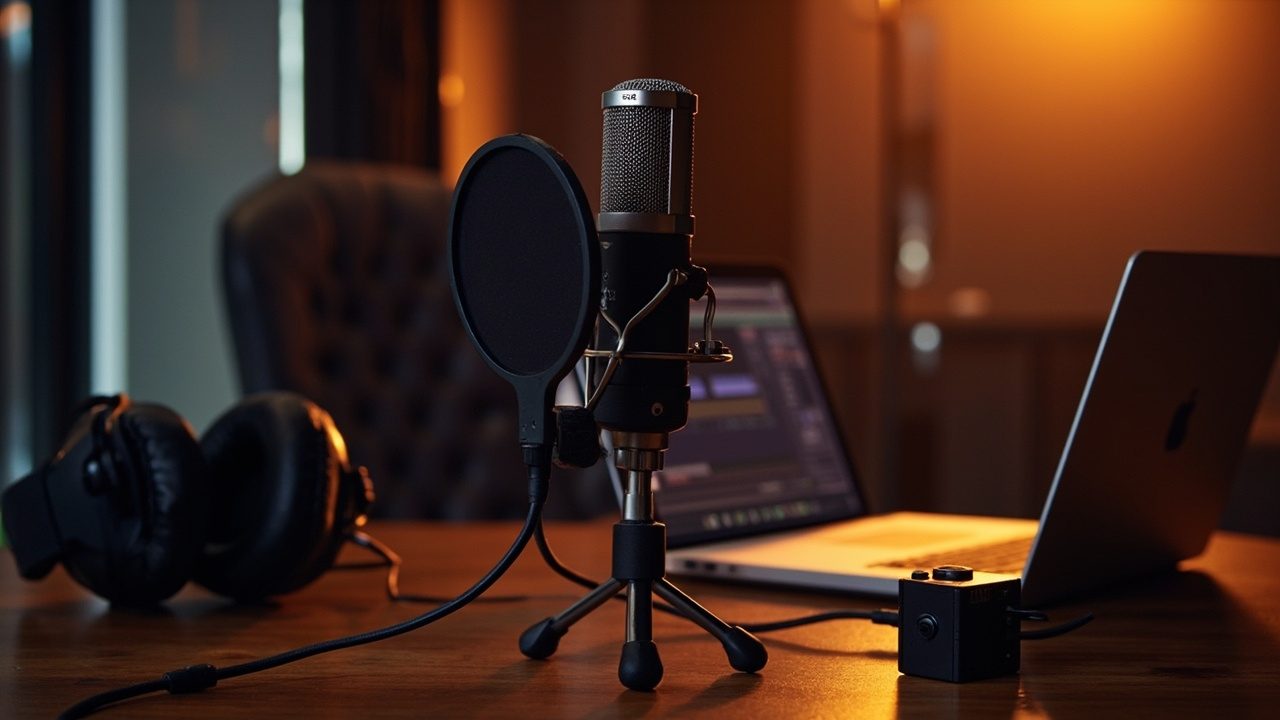
Are you looking for a microphone ready for podcasting, live streaming, and home-studio use without multiplying boxes? The Shure MV7 microphone is aimed at creators who want a dense, controlled voice and a simple workflow. After several weeks of real takes (streams, voice-overs, remote interviews), here is a no-frills test: qualities, limits and concrete recommendations to obtain reliable sound day after day.
Handling and build: a pro body, a domesticated form factor
The MV7 takes the silhouette of the SM7B in a more compact format. Metal chassis, stable yoke, angle knob: it exudes robustness. The standard articulating arm mount is practical to get close to the mouth and reduce room noise. The bundle includes both USB cables (A and C), enough to start without an external audio interface.
The touch panel groups mute, monitoring/mix and level. You’ll need to get used to the capacitive touch, but the response is clear and navigation is fast, even live.
Shure MV7 microphone: settings, connections and software
The dual USB/XLR connector changes the game. In USB, the mic becomes a dedicated sound card, with a mini-jack headphone output and direct control. In XLR, it plugs into a preamp or an interface for a more ambitious chain, without internal processing.
The software ShurePlus MOTIV centralizes the adjustments: gain, voice profile, equalization, compression and gate. Presets are useful to go fast; the advanced mode lets you sculpt finely.
Auto Level mode and manual mode: work fast, fine-tune
The Auto Level mode continuously governs the gain to avoid clipping during a live or an animated conference call. It’s a real safety net for streamers. In manual, you keep control of the level, the EQ with three curves (flat, bass boost, presence) and the compression (off, light, medium, heavy).
USB vs XLR: which path to choose depending on the context?
In USB, you enjoy headphone monitoring with near-zero latency and the integrated DSP processing; perfect for solo creators and mobility. In XLR, you use more musical preamps, an external compressor or a channel strip; ideal if you already own a studio setup.
Sound performance: dense voice, controlled details
The MV7 is a dynamic cardioid capsule optimized for spoken and sung voice. The reproduction is rounded in the low-mid, with a controlled presence around 3–5 kHz that helps it cut through in a mix without aggression. The mic gains body when you place yourself at 5–10 cm, classic with the proximity effect.
For podcasts, the result is radio-like, slightly warm. For streaming, consonants remain readable even during heavy gameplay, and sibilants don’t bite if you keep a good axis. For singing, it favors pop/variety or rap-spoken vocal; for very airy ballads, a condenser will offer more air.
Noise management and directivity: useful even in untreated rooms
The cardioid directivity effectively rejects the rear and sides. Paired with Shure’s “Voice Isolation” technology, it tames keyboard noise, room noise and light venting. Internal protection helps, but an external pop filter is still recommended for explosive consonants at close distance.
In a living room, software gate helps tighten the noise floor. The threshold setting should stay subtle to avoid “pumping” between sentences. In XLR, a light hardware expander can offer a more natural result.
Key measurements and real-world performance
Rated response: 50 Hz–16 kHz. In practice, infrabass is contained, advantageous to limit desk rumble. The high end is smooth; we avoid too-bright highlights and keep clear consonant articulation.
USB converter: up to 24 bits/48 kHz. The headphone output has enough headroom to monitor in the noise of a room. On XLR, the signature remains the same, with an added “grain” depending on the preamp used.
Quick comparison: MV7, SM7B, Blue Yeti, Rode NT‑USB
Positioning: the MV7 targets the studio/stream hybrid. The SM7B is more linear and requires a solid preamp. USB condenser mics like Yeti or NT‑USB aim for air and sensitivity, at the cost of less generous room rejection.
| Model | Type | Connection | Pattern | Highlights |
|---|---|---|---|---|
| Shure MV7 | Dynamic | USB + XLR | Cardioid | Flexible workflow, dense voice, MOTIV software |
| Shure SM7B | Dynamic | XLR | Cardioid | Radio reference, requires a stout preamp |
| Blue Yeti | Condenser | USB | Multi-patterns | More air, captures more of the room |
| Rode NT‑USB | Condenser | USB | Cardioid | Clear voice, sensitive to environmental noise |
Need a gaming mic reference that's more plug-and-play? Check out our test of the HyperX Quadcast to gauge voice rejection and control differences.
Accessories and ergonomics: arms, headphones and understated design
The MV7 likes to be mounted on an articulated arm to bring it close to the mouth and free up the desk. A shock mount isn’t essential, but it reduces handling noises. The headphone monitoring offers a mix between mic return and computer sound, handy for dialing in your voice over a track or a gameplay track.
The tactile mute is reliable; consider visually placing a marker on your streaming console to avoid forgetting at the start of a live.
Voice-over, stream, teleworking: the use cases where it excels
- Podcast and narration: warm tone, readable diction, controlled projection.
- Streaming: good resistance to background noise, quick adjustments via MOTIV.
- Business calls: immediate intelligibility without complicated EQ.
- Pop/Rap singing: flattering proximity; serious recordings possible in XLR.
If you’re unsure whether a dynamic or condenser is better for your room, this guide helps you decide: dynamic microphone or condenser.
Limitations and points of caution
The internal pop protection remains adequate, but an external pop filter secures close-up takes. Sibilants are tame; avoid boosts too generous when your voice is already bright.
The touch control can be triggered accidentally during mic readjustment; lock your levels in MOTIV before going live. Auto mode can pump slightly if the desk speaker is loud; don’t hesitate to switch to manual in these situations.
Placement tips to maximize the result
- Distance: 5 to 10 cm, slightly off-axis to limit plosives.
- Angle: 20–30° off-axis, aimed at mouth height.
- Room: curtains drawn, rug on the floor; a shelf behind you helps break reflections.
- Gain: aim for peaks at −12/−10 dBFS in manual to keep headroom.
A light de-esser in your DAW can smooth very sibilant voices. In XLR, a soft optical compressor enhances the grain without tiring the ear.
Fidelity to specifications and real-world usage
The MV7 lists a 50 Hz–16 kHz response, cardioid. In practice, it’s this high roll-off that makes the mic less sensitive to keyboard chuffs and bright transient shocks. Voices gain solidity; the airiness of a condenser is not the objective here, and that’s intentional.
As for hiss, the software processing and close-miking keep a clean floor as soon as you adjust the gain. Off-axis rejection remains the major asset for content shot in a living space.
What we liked, what we’d change
- + Ultra-practical USB/XLR hybrid, fast MOTIV workflow.
- + Warm tone, readable presence, good performance in untreated environments.
- + Headphone output, direct mix, responsive touch controls.
- − USB Micro-B port feels dated, touch controls prone to false manipulations.
- − Requires close proximity technique to express its full character.
Verdict: our take after several weeks
The Shure MV7 ticks almost all boxes for contemporary creation: its seriousness, simplicity, adaptability. In USB, you get a broadcast-ready result with little effort. In XLR, you follow the natural progression of a studio setup. All of this with an excellent price/performance ratio given its versatility.
If your priority is a consistent voice, little hassle, and room rejection higher than consumer USB condensers, the MV7 is a strong choice. Perfectionists of “high-end air” will lean toward a condenser and a treated space; for everything else, this mic is a reliable companion.
Fiche récap’ et réglages conseillés
- Type: dynamic, cardioid, voice-oriented.
- Connexion: USB up to 24 bits/48 kHz + analog XLR.
- Monitoring: built-in headphone output, direct mix/PC.
- Software: MOTIV with voice profiles, EQ, compression, gate.
- Placement: 5–10 cm, slight off-axis, pop filter recommended.
Typical settings for podcast/stream
Distance 7 cm, voice profile dark or neutral depending on timbre; compression “medium”, presence EQ + light low-cut if your room booms in the lows. Subtle gate to cut distant breaths, without harming sentence endings. For music, add a soft de-esser and 1–2 dB of broad shelves if needed.
Want to compare other signatures and technologies? Our piece “dynamic microphone or condenser” helps you choose based on your room, your voice and your workflow. To evaluate a gaming-oriented competitor, also browse the HyperX Quadcast test and gauge the difference in rejection and grain.