
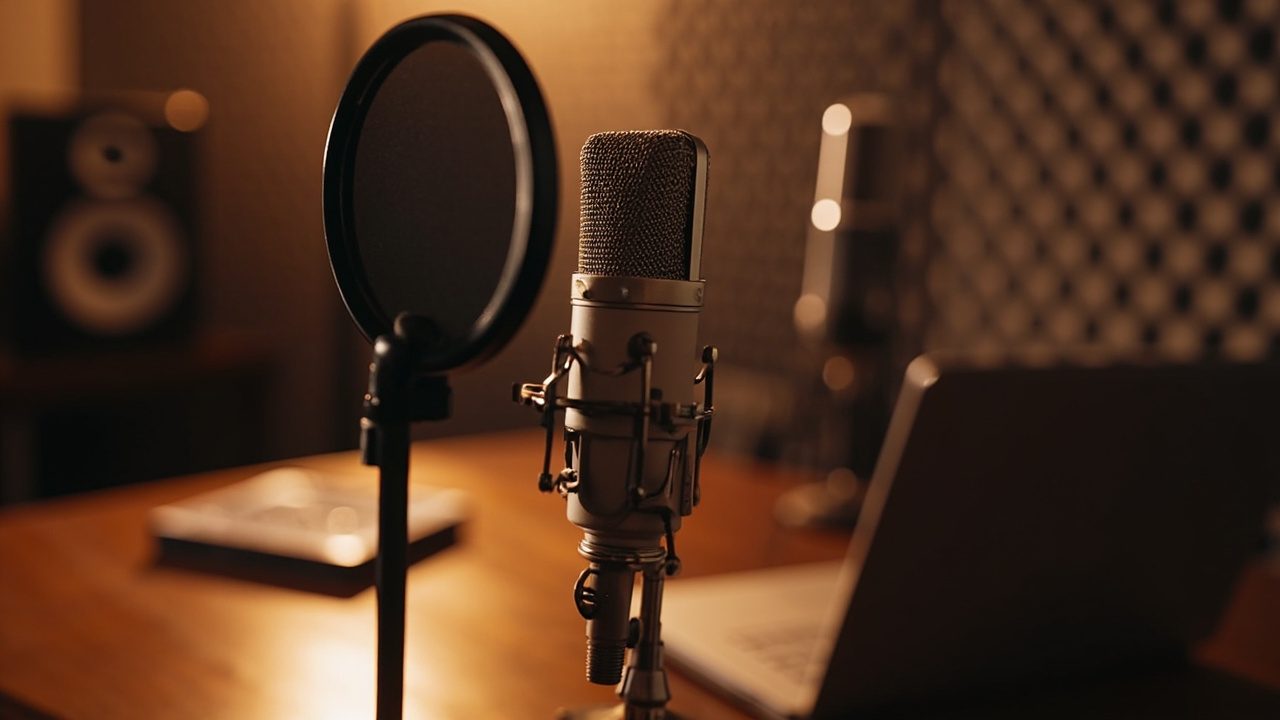
- Pop filter in front of the mouth: goodbye plosives, hello intelligibility.
- Elastic suspension: isolates vibrations from the mic stand.
- Reflector behind the microphone: useful in lively rooms.
- Arms or heavy stand: stable position, precise adjustments.
Directivité et gestion du bruit dans un home‑studio
The cardioid picks up from the front and rejects the rear. Point the back of the mic toward the noise source (window, PC). A good mouth-to-mic distance: 10 to 15 cm with a filter, a light angle (10–20°) to limit plosives without losing clarity.
Fiches techniques utiles, sans jargon inutile
- Frequency response : look for the bump around 2–5 kHz for presence, and the 8–10 kHz area for sibilants.
- Max SPL : rarely limiting in rap vocals, but useful for screams or aggressive ad‑libs.
- Self‑noise : the lower it is, the more discreet the breath on calm passages.
| Model | Type | Character | Ideal if… |
|---|---|---|---|
| Rode NT-USB | USB, condenser | Clear, ready to use | Need simplicity and mobility |
| AT2035 | XLR, condenser | Present, controllable | Versatile rap, mid voice |
| AKG C214 | XLR, condenser | Forward, incisive | Cut through dense mixes |
| SM7B | XLR, dynamic | Dense grain | Untreated room, powerful voice |
| TLM 103 | XLR, condenser | Definition, silky | Treated booth, nuanced voice |
Réglages de prise et technique de voix : le détail qui change tout
Before hitting record, do your gain staging: speak, shout, whisper. Adjust so peaks stay below −6 dBFS. No red, no clipping. Record at 24-bit/48 kHz for a comfortable margin.
Placement et constance
- Microphone height at mouth level, slight off-axis tilt.
- Floor marker to keep the same position between takes.
- Headphone monitoring at a reasonable volume to avoid bleed.
Traitements légers à la capture
- High-pass around 70–90 Hz if the voice is “muddy.”
- Sof de-esser if the S hiss too much.
- Light compression (2:1 to 3:1, 3–5 dB reduction) to smooth the flow.
I always keep a dry track and a guide track with a bit of processing for the artistic side. The right mic makes plugins become finishes, not crutches.
Mini‑comparatif : choix éprouvés par usage
- Raspy and close voice: Shure SM7B or RE20, excellent room control.
- Clear and precise voice: Rode NT1, AT2035, AKG C214.
- Minimalist quick setup: Rode NT‑USB, HyperX Quadcast, Blue Snowball.
- Treated booth, pro standard: Neumann TLM 103, Warm Audio WA‑47jr.
Méthode d’achat : prioriser ce qui s’entend vraiment
Record 16 takes with three different mics in the same room, same distance, same volume. Listen on your monitors and on your smartphone. Note intelligibility of the words, Sibilance handling, body of the voice, listening fatigue. The best isn’t always the most expensive; it’s the one that serves your identity.
Checklist avant de valider le panier
- Compatibility with your interface/computer.
- Included accessories (suspension, pop filter, case).
- Return policy to test calmly at home.
- Availability of parts (cables, stands, foams).
Ressources pour approfondir et progresser
If you're still unsure about the mic type, keep this benchmark: dynamic for control, condenser for detail. The nuances and edge cases are unpacked in the in-depth article cited above. For a balanced take ready to mix, the AT2035 remains a safe bet, detailed in the dedicated test.
À retenir pour des voix qui claquent
A good mic does not erase the flaws of the room, but it highlights your flow and your intent. Target directivity, sensitivity, and noise; choose between dynamic and condenser depending on your environment, mind the distance and accessories. The rest is played in interpretation, consistency, and mix choices that are sober but effective.
To go further and refine your ear, explore the comparisons and technical dossiers from L’Atelier du Microphone. A test session is worth a thousand product sheets: record, listen, choose, then rap as if the microphone didn’t exist.
À retenir pour des voix qui claquent
Un bon micro n’efface pas les défauts de la pièce, mais il met en valeur votre flow et votre intention. Ciblez la directivité, la sensibilité et le bruit, choisissez entre dynamique et condensateur selon votre environnement, soignez la distance et les accessoires. Le reste se joue dans l’interprétation, la régularité et des choix de mix sobres mais efficaces.
Pour aller plus loin et affiner votre oreille, explorez les comparatifs et dossiers techniques de L’Atelier du Microphone. Une séance test vaut mille fiches produit : enregistrez, écoutez, choisissez, puis rappez comme si le micro n’existait plus.
Choosing a microphone for recording rap is not a detail of equipment. It’s the building block that puts your voice in the foreground, that reveals the grain, the breath, the timbre and the attacks of consonants. When I capture a verse in an untreated room, I know in two seconds whether the energy gets through. The right mic saves takes, time, and sometimes inspiration.
Rap requires clear articulation, transients that snap, and a clean bass that doesn’t smear. We’re talking about vocal take more than studio effect. Before getting carried away with a model, look at what you want to hear: controlled aggression, silky presence, neutral tone ready to mix? The answers guide the technology, the directivity, and the audio chain.
Ce que les rappeurs attendent réellement d’un micro de studio
In a dense production, the mic must carve the voice in the mix without sibilance or plosives. Ad-libs must remain readable, whispered ones as well as screams must keep their intent. Consistency is queen: same distance, same angle, same level, session after session. This is where a stable, easy-to-position and consistent model takes the edge.
Qualités sonores qui font la différence
- Precise attack for consonants and sixteenth notes.
- Mids present but not shrill, to carry the diction.
- Taut low end for dark timbres and close to the microphone.
- Bright highs without excessive "air" that highlights the sibilants.
Dynamique ou statique : choisir l’outil qui sert le flow
The family of microphones mainly divides between dynamic microphone and condenser microphone. Dynamics handle high sound pressure levels, tolerate more reverberant spaces, and offer a denser grain. Condensers deliver fine resolution, a more detailed image, and a more open top end.
Need a detailed guide to decide? The topic is developed here: dynamic or condenser, how to choose according to use. In rap, both hold up: a straight dynamic for room control, a condenser for micro-detail and clarity.
Quand privilégier quoi
- Untreated room, powerful voice, strong proximity: dynamic recommended.
- Treated home-studio, nuanced voice, need for finesse: condenser recommended.
- Very sibilant voice: beware condensers that are too bright.
Micro pour enregistrer du rap : nos scénarios concrets, du budget au premium
No matter the price, keep an eye on the cardioid directivity, the frequency response, and the self-noise level. This trio dictates the cleanliness of the take, presence in the mix and ease of processing.
Budget serré : starter pack efficace
- Rode NT-USB : USB plug-and-play, clear sound, comes with pop filter and desk stand. Perfect to start without an interface.
- Audio-Technica AT2020 (XLR) : safe bet, neutral, takes EQ well. Requires a audio interface basic.
- Blue Snowball (USB) : entry level, quick for mock-ups and freestyles.
Milieu de gamme : texture et fiabilité
- Audio‑Technica AT2035 : a classic, with built-in high-pass filter and pad, solid mids. Excellent value for money.
- Rode NT1 (nouvelle génération) : very low noise, soft color, ideal for hushed voices or storytelling.
- AKG C214 : presence, top for cutting through modern productions.
Haut de gamme : les standards des cabines
- Shure SM7B (dynamic) : grain reminiscent of radio/rap, rejects the room well. Requires a preamp with a lot of gain or a booster.
- Neumann TLM 103 (condenser) : precise, controlled brilliance, present body. Reveals the nuances and weaknesses of the room.
- Electro‑Voice RE20 (dynamic) : very regular in movement, proximity effects controlled, clean low end.
USB, XLR, hybride : quel branchement pour votre setup ?
USB : simplicity reigns, latency manageable, zero configuration. Ideal for quick recording, streaming, or working on the move. Limitation: limited upgradability.
XLR : the studio path. Going through a dedicated audio interface, better preamps, precise monitoring, upgrade options. Higher initial investment but a robust chain.
Hybride : some models combine USB/XLR (e.g., Shure MV7). You start on USB, switch to XLR when the studio grows. Practical for those who want a “lifetime” mic from the start.
Le rôle décisif de la pièce et des accessoires
A bad environment sabotages any mic. A bit of acoustic treatment changes the game: absorbing panels, rugs, heavy curtains, an open wardrobe with clothes. Aim for fewer noisy ambiances and a shorter reverberation time.
Les indispensables à petit prix
- Pop filter in front of the mouth: goodbye plosives, hello intelligibility.
- Elastic suspension: isolates vibrations from the mic stand.
- Reflector behind the microphone: useful in lively rooms.
- Arms or heavy stand: stable position, precise adjustments.
Directivité et gestion du bruit dans un home‑studio
The cardioid picks up from the front and rejects the rear. Point the back of the mic toward the noise source (window, PC). A good mouth-to-mic distance: 10 to 15 cm with a filter, a light angle (10–20°) to limit plosives without losing clarity.
Fiches techniques utiles, sans jargon inutile
- Frequency response : look for the bump around 2–5 kHz for presence, and the 8–10 kHz area for sibilants.
- Max SPL : rarely limiting in rap vocals, but useful for screams or aggressive ad‑libs.
- Self‑noise : the lower it is, the more discreet the breath on calm passages.
| Model | Type | Character | Ideal if… |
|---|---|---|---|
| Rode NT-USB | USB, condenser | Clear, ready to use | Need simplicity and mobility |
| AT2035 | XLR, condenser | Present, controllable | Versatile rap, mid voice |
| AKG C214 | XLR, condenser | Forward, incisive | Cut through dense mixes |
| SM7B | XLR, dynamic | Dense grain | Untreated room, powerful voice |
| TLM 103 | XLR, condenser | Definition, silky | Treated booth, nuanced voice |
Réglages de prise et technique de voix : le détail qui change tout
Before hitting record, do your gain staging: speak, shout, whisper. Adjust so peaks stay below −6 dBFS. No red, no clipping. Record at 24-bit/48 kHz for a comfortable margin.
Placement et constance
- Microphone height at mouth level, slight off-axis tilt.
- Floor marker to keep the same position between takes.
- Headphone monitoring at a reasonable volume to avoid bleed.
Traitements légers à la capture
- High-pass around 70–90 Hz if the voice is “muddy.”
- Sof de-esser if the S hiss too much.
- Light compression (2:1 to 3:1, 3–5 dB reduction) to smooth the flow.
I always keep a dry track and a guide track with a bit of processing for the artistic side. The right mic makes plugins become finishes, not crutches.
Mini‑comparatif : choix éprouvés par usage
- Raspy and close voice: Shure SM7B or RE20, excellent room control.
- Clear and precise voice: Rode NT1, AT2035, AKG C214.
- Minimalist quick setup: Rode NT‑USB, HyperX Quadcast, Blue Snowball.
- Treated booth, pro standard: Neumann TLM 103, Warm Audio WA‑47jr.
Méthode d’achat : prioriser ce qui s’entend vraiment
Record 16 takes with three different mics in the same room, same distance, same volume. Listen on your monitors and on your smartphone. Note intelligibility of the words, Sibilance handling, body of the voice, listening fatigue. The best isn’t always the most expensive; it’s the one that serves your identity.
Checklist avant de valider le panier
- Compatibility with your interface/computer.
- Included accessories (suspension, pop filter, case).
- Return policy to test calmly at home.
- Availability of parts (cables, stands, foams).
Ressources pour approfondir et progresser
If you're still unsure about the mic type, keep this benchmark: dynamic for control, condenser for detail. The nuances and edge cases are unpacked in the in-depth article cited above. For a balanced take ready to mix, the AT2035 remains a safe bet, detailed in the dedicated test.
À retenir pour des voix qui claquent
A good mic does not erase the flaws of the room, but it highlights your flow and your intent. Target directivity, sensitivity, and noise; choose between dynamic and condenser depending on your environment, mind the distance and accessories. The rest is played in interpretation, consistency, and mix choices that are sober but effective.
To go further and refine your ear, explore the comparisons and technical dossiers from L’Atelier du Microphone. A test session is worth a thousand product sheets: record, listen, choose, then rap as if the microphone didn’t exist.
À retenir pour des voix qui claquent
Un bon micro n’efface pas les défauts de la pièce, mais il met en valeur votre flow et votre intention. Ciblez la directivité, la sensibilité et le bruit, choisissez entre dynamique et condensateur selon votre environnement, soignez la distance et les accessoires. Le reste se joue dans l’interprétation, la régularité et des choix de mix sobres mais efficaces.
Pour aller plus loin et affiner votre oreille, explorez les comparatifs et dossiers techniques de L’Atelier du Microphone. Une séance test vaut mille fiches produit : enregistrez, écoutez, choisissez, puis rappez comme si le micro n’existait plus.