
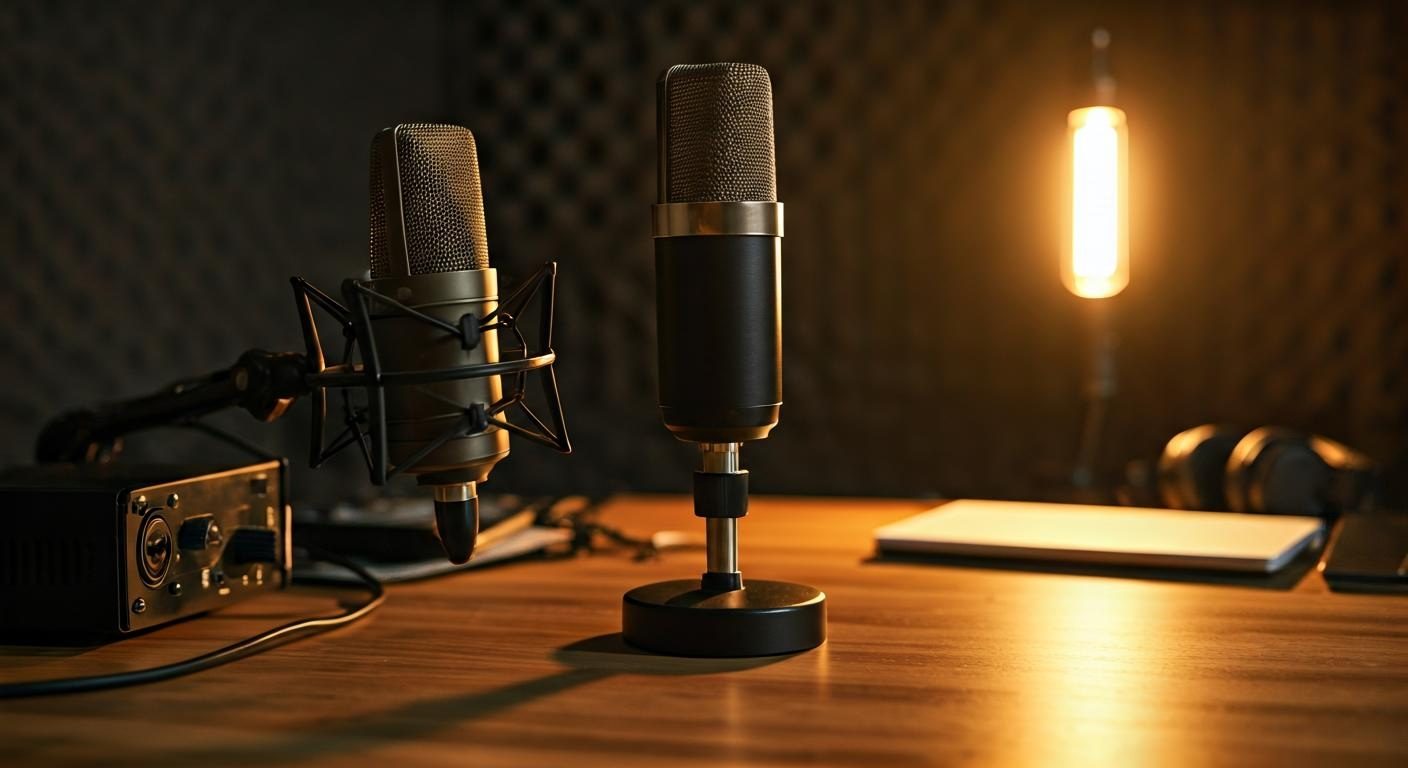
Condenser microphones offer increased fidelity and sensitivity for voice, instruments, and podcasts. This article guides readers in 2026 toward an informed choice of a microphone suited to their use and budget, prioritizing useful information and practical advice. You will read clear explanations, fair comparisons, and real-world studio- and home-recorded experiences. I will also share tips from real configurations, so that every purchase becomes a durable investment, with no mystery.
Understand condenser microphones and why they dominate today
A diaphragm captures pressure variations and transforms acoustic vibration into an electrical signal, via an electrostatic capsule powered by a reference voltage. This architecture stands out for its high sensitivity and a very broad frequency range, which makes these models particularly adept at reproducing the voice with body and the details of instruments. In practice, this degree of finesse explains why professionals prefer them for studio vocals and high-quality podcasts.
From a technical standpoint, the choice of capsule directly influences transparency and sonic expression. Large-diaphragm mics bring a mild warmth and a reassuring presence for spoken or sung voice, while small-diaphragm mics capture high frequencies and harmonics with remarkable precision. This duality accompanies you across projects, from intimate streaming to professional mixing. In untreated environments, the difference also hinges on the microphone's ability to resist reflections and deliver a faithful image.
Diaphragm and sensitivity: large diaphragm vs small diaphragm
For close-range voices, large-diaphragm mics offer a natural presence and a slightly colored midrange, which avoids a flat, "rhythmic" effect. The small diaphragm proves more incisive on the high frequencies and instrumental details, useful when textures and nuances matter. In practice, if your focus is singing or radio speech, favoring a large diaphragm can facilitate the mix work. For acoustic guitars, pianos, or delicate percussion, the small diaphragm reveals greater intelligibility without an excess of sibilants.
Directivity and frequency response: choose according to sources
Directivity profiles guide integration into the space. The cardioid directivity is practical for most home configurations: it mainly captures what is in front and minimizes some reflections behind. Other modes exist, such as omnidirectional, useful when you seek a more enveloping sound image, and the figure 8 for duo recordings. The wide frequency range ensures fidelity across the entire spectrum, which is crucial for voices and instruments requiring precision on the highs and harmonics. The choice will depend on the acoustics of your room and the desired result.
Phantom power and interface compatibility
The power input is essential. Phantom power (usually 48 V) powers the condenser mic and avoids the need for heavy external supplies. To ensure a clean chain, check compatibility with your interface or preamp: the XLR interface is the standard configuration that favors clarity and gain control. Some USB interfaces incorporate power and reduce the need for additional hardware, but you must check the impedance and noise introduced by the interface itself.
Top condenser microphones for 2026: uses and selection tips
To guide your choice, adopt a usage-based approach: voice, podcast, studio singing, instruments, or voice-over. This framework helps you target the sensitivity and background noise, but also to assess total cost and the durability of the equipment. In this selection, you will see options covering varied budgets and configurations suited to different spaces. For those who want to explore the world of singing, investing in equipment can be accompanied by a targeted vocal approach; you can consult this guide on the time required to learn to sing to coordinate listening and technique alongside the purchase.
- Recent voice and podcast recordings – versatile microphone, good management of noise and reverberation, ideal for clear speech and podcast episodes.
- Studio singing – large-diaphragm model, presence in voice and transparency in mid frequencies, useful for realistic and intelligible recordings.
- Acoustic instruments – small capsules or multi-pattern configurations offer faithful rendering of details, strings, and dynamics.
- Voice-over and narration – precision of recordings and low coloration; omnidirectional may be considered if placement around the speaker is flexible.
- Budget-friendly – robust and simple cardioid condenser options, perfect to start without sacrificing quality.
Practical example: in my studio, a Neumann U87 Ai delivered a warm and natural voice, while an AKG C414 XLII captured instrument textures with great precision.
As you gain experience, you will find that the choice is not only about price. Robustness, thermal stability, and consistency of performance are criteria just as decisive as the guidance on the intended uses. For a concrete overview, visit L’Atelier du Microphone and compare the technical datasheets corresponding to your setup.
Summary table of flagship models and their uses
The following table summarizes the most common options in 2026, indicating the main uses and price ranges. If you are torn between two models, this overview helps you quickly target the parameters that make the difference.
| Model | Directivity | Frequency range | Sensitivity | Compatibility | Typical uses | Price (range) |
|---|---|---|---|---|---|---|
| Neumann U87 Ai | Cardioid / Omni / Figure 8 | 20 Hz – 20 kHz | High | XLR | Studio voice, voice-over, piano, ensemble | €3,500 – €4,500 |
| AKG C414 XLII | Multi-pattern | 20 Hz – 20 kHz | Very high | XLR | Voice, instruments, acoustic percussion | €1,200 – €1,900 |
| Audio-Technica AT4040 | Cardioid | 20 Hz – 20 kHz | High | XLR | Singing, voice-over, acoustic guitar | €400 – €600 |
| Rode NT1-A | Cardioid | 20 Hz – 20 kHz | High | XLR | Speech, podcasts, soft singing | €200 – €320 |
Practical installation and setup tips
Success depends as much on the microphone as on its positioning and the environment. Preparing the space, setting the gain, and limiting reflections are simple steps that improve clarity and coherence of the result. The goal is to obtain a clean signal, ready to be mixed without requiring heavy post-production corrections.
To optimize listening and rendering, favor a stable position, anti-vibration support, and basic acoustic treatment. These elements help obtain a more precise and faithful image. The rest of this article provides best practices to adopt, beyond simply choosing the microphone.
Positioning for voice and instruments
For a spoken or sung voice, a distance between 15 and 30 cm is often ideal, aiming slightly toward the mouth opening to capture natural resonance without saturating the diaphragm. Test recording angles around 0 to 15 degrees to avoid plosives and hum. For an acoustic guitar or a piano, experiment with angle and distance to obtain a rich image without excess bass or cold air. Each source deserves a small adjustment to find the right balance between presence and air.
Noise and reverb management
Isolating the recording station and working on the environment is a step that can transform your sound. A well-chosen microphone can remain effective even in a medium-sized room, but acoustic treatment quickly becomes an asset. Place panels or absorbers on the direct walls and use heavy curtains near windows to limit reflections. If background noise persists, favor microphone settings and, if possible, enable a slight gain reduction rather than increasing the level, to avoid boosting the noise.
Phantom power and proper cabling
Checking the power supply is a practical but crucial step. A stable and properly set power supply avoids unwanted noises and distortions linked to voltage variations. Avoid unpowered hubs or poorly insulated cables that can introduce interference. For XLR sources, choose good-quality cables and ensure the connections are clean and firmly seated. If you use USB interfaces, confirm that the current mode and gain level managed by the software are compatible with the chosen microphone.
Move into recording with confidence and creativity
The choice of a condenser microphone suited to your use opens the door to a recording quality that speaks for itself. The goal is not merely to buy the most expensive model, but to find the one that matches your voice, your space, and your workflow. Take time to test, listen, and compare results in real conditions. A well-chosen microphone becomes the foundation of your sonic identity and a true lever of creativity. If you want to broaden your practice, don't hesitate to explore different capture configurations and read user feedback to enrich your own experience. If you want to go deeper, consult other resources related to your space and uses, and feel free to return for personalized advice.
Concise conclusion and recommended next steps
In summary, choosing a condenser microphone that fits your voice, space, and project type depends. Prefer a large-diaphragm capsule for voices and podcasts, or a small-diaphragm for instrument detail and textures. Opt for a directivity suited to your room and ensure phantom power and the interface are compatible to avoid unwanted noise. Test in real conditions, compare, and let your artistic sensitivity guide your investment. To go further, explore our guides on capture configurations and user feedback to refine your choice and your workflow. If you wish to deepen, consult other resources related to your space and uses, and don't hesitate to return for personalized advice.