
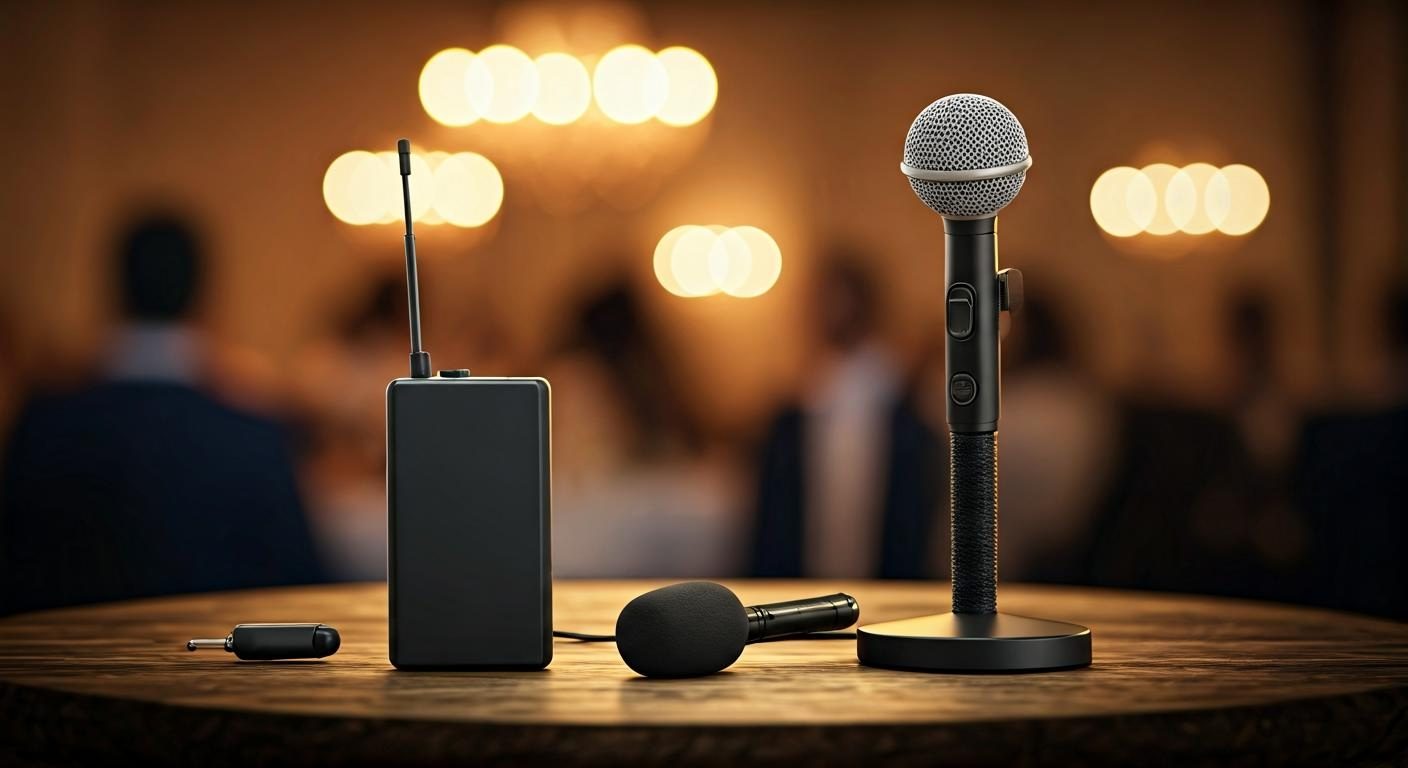
A whispered vow, a burst of laughter, a tear held back. So that everything is heard with elegance, the choice of the best microphone for a wedding becomes strategic. The audience expects clear speech, the video demands clean sound, and the technology must stay invisible. This article shares a clear methodology, nourished by field experiences, to choose a reliable, discreet system tailored for your ceremony.
Identify the “best microphone for a wedding” according to your scenario
Each wedding has its sound topology. Windy outdoor, reverberant chapel, convivial reception hall: constraints vary. First define the uses: vows, speeches, officiant, musicians, ambience of the guests. Then determine the capture distance, the desired mobility, and the level of discretion expected in front of the cameras.
An immobile officiant and a nervous couple but not at ease with gear? A discreet lavalier mic on the officiant often covers 80% of the needs. A reception paced by spontaneous toasts? A versatile handheld mic becomes reassuring for the hosts.
Microphone formats: find the right tool at the right moment
Four formats dominate ceremonies. Each has its strengths and limitations in real conditions. The idea is not to accumulate them all, but to assemble the winning duo according to your venue and your style.
- Lavalier mic: ultra-discreet, hands-free, ideal for the officiant and close-range vows.
- Handheld wireless mic: reassuring for speeches, dynamic, easy to pass from one speaker to another.
- Head-worn mic: clear and stable voice, perfect for a mobile officiant, discreet under hair.
- Shotgun (boom) on a pole: useful as video reinforcement, captures at a distance in calm conditions.
To minimize surprises, pair a stage system (diffusion) with a solution dedicated to camera recording. The toasts will remain audible in the room and clean in the film.
Directivity and capture: the anti-noise compass
Directivity guides the mic’s pickup pattern. Cardioid, supercardioid, omnidirectional: each pattern shapes the sound and the risk of feedback. A well-placed cardioid prioritizes the voice, attenuates the audience, and tolerates movement somewhat.
Omnidirectional lavaliers keep a natural timbre when positioned 15–20 cm from the mouth. For reverberant spaces, a cardioid directivity in hand or on a head-worn mic secures intelligibility. A sound engineer summarized: “the right capsule in the right place is worth more than a big EQ fix.”
Want to go further on polar patterns? The guide on directivity helps choose between cardioid, hypercardioid and omni depending on the room.
Wired or RF: mobility, stability, invisibility
Wired remains the benchmark for pure reliability, no battery to monitor, no possible interference. At a town hall podium or for a static reader, it’s a solid choice. On stage with movement, the wireless mic becomes essential.
For RF systems, favor a diversity receiver or “true diversity.” Two antennas and two radio paths reduce dropouts. Keep a clear distance between transmitters and receiver, and raise the antennas above the crowd to improve range.
Capsule and character : clarity, warmth, durability
A condenser capsule excels in detail and nuance, perfect for soft vows or an acoustic singer. A dynamics microphone handles noisier environments and inexperienced hands better, an asset for lively toasts.
A small field tip: a low-cut filter at 80–100 Hz cleans up footfalls, light wind, and hand transfers. A fine foam windscreen remains almost invisible, and protects effectively indoors.
Frequency management : the nerve of RF
In France and, more broadly, across Europe, microphone systems can operate in the bande UHF 470–694 MHz band according to local PMSE authorizations. The 863–865 MHz free slot remains practical for consumer kits, with power and channel limits.
Before the big day, scan the frequencies, avoid the DJ’s Wi‑Fi and the links already in use. A good frequency management reduces dropouts. Keep a 300–500 kHz gap between channels and memorize a backup bank in case of saturation.
Ambience and music : painting the scene without muddying the voices
For the filming, add a pair of discreet ambience mics: a shotgun mic away from the dance floor for the applause, or a light stereo pair at a distance from the speakers. A compact recorder at the control area will capture the main mix, plus an ambient backup to recreate the space.
Looking for references for ambience captures at festivals or cocktail parties? This comparison on ambient microphones provides useful leads to adapt to a wedding.
Express table : which mic for which moment ?
| Situation | Recommended format | Main advantage | Attention point |
|---|---|---|---|
| Vows at the altar | Wireless lavalier on officiant + backup | Discretion, hands-free | Risk of clothing rubbing |
| Speeches at the cocktail | Handheld wireless mic | Easy handling | Guest mic technique |
| Lectern reading | Wired cardioid | Total stability | Cable to secure |
| Outdoor ceremony | Head-worn wireless + windscreen | Clarity in wind | Hairstyle considerations |
| Guest ambience | Shotgun/boom or light stereo | Video immersion | Placement away from speakers |
Petits réglages qui font une grande différence
- Enable a light limiter on the mixer to prevent unexpected peaks.
- Position the lavalier to avoid rubbing against clothing, between the second and third button.
- Keep 5–10 cm between mouth and handheld mic, aimed squarely at the lips.
- Keep a windshield for outdoor use, even in calm weather.
- Prepare a stand-alone backup recording away from the DJ console.
Budget and trade-offs : where to spend
Priority goes to the capsule, the RF link, and power. Invest in reliable batteries or cells, and avoid exotic brands for radio links. Renting professional gear for the weekend can be cheaper than buying an average kit and worrying about it all day.
| Besoins | Location estimative | Achat estimatif | Conseil |
|---|---|---|---|
| 1 lavalier HF + 1 main HF | €80–€150 / day | €350–€900 | Rental if occasional use |
| 2 lavaliers HF + recorder | €120–€220 / day | €600–€1,400 | Ideal for video + redundancy |
| Wired lectern mic + compact speaker | €40–€90 / day | €250–€700 | Simple town hall solution |
Gestion des risques : anticiper pour rester serein
Double the critical points: lavalier on the officiant and handheld mic ready to go, two fresh batteries on each transmitter. Keep a spare XLR cable in case a receiver drops. A checklist prevents improvisation when emotion rises.
“The best sound plan is the one that keeps working when everything speeds up.” — field notes from a wedding sound recordist
- Venue scouting, distances, and power points.
- Plan B if it rains: canopy, repositioning, resetting gains.
- Coordination with the DJ and videographer to avoid frequency clashes.
Acoustics and placement : taming reverberation
In a sonically lively church, bring the mic close to the mouth and reduce the sound reinforcement. Avoid amplifying the whole space; prioritize frontal intelligibility. The speakers should aim at the guests, not the walls. A discreet rug in front of the altar limits floor reflections.
For a modern glass-walled room, lower the volumes, favor directional capsules, and slightly delay the secondary speakers if necessary.
Recommended standard configuration and reference models
A proven setup for most ceremonies: a discreet wireless lavalier on the officiant, a handheld wireless mic for interventions, output from the mixer to a recorder and camera return. If possible, dual outputs: one "secure" track at a lower level to prevent saturation.
| Element | Role | Pro tip |
|---|---|---|
| Wireless lavalier | Vows and officiant | Low-cut at 80 Hz, stable placement |
| Handheld wireless | Guest speeches | Gaffer tape for distance cue |
| Receiver + mixer | Mixing and diffusion | Memory scenes with tested levels |
| Standalone recorder | Backup audio | Secondary track -12 dB |
| Accessories | Protection and comfort | windshield, clips, skin-safe adhesives |
Tests and rehearsals : stress-proofing
Block 20 minutes before the guests for a true line-check. Speak at real level, walk, hug, laugh. The sensors will react as on the big day. A sound check the night before in the same venue remains the safest option, especially if the weather changes.
Watch the RF and audio indicators; if a channel blinks, switch to a pre-programmed backup frequency. Also prepare long cables in case of a stage contingency.
Mini field reports : three real cases
Full town hall, no mics provided. Solution: wired cardioid on lectern, a small speaker behind the audience. Result: clear voice, zero feedback. Bonus: the room wasn’t over-amplified.
Garden ceremony, light wind. Discreet head-worn mic for the officiant, spare lavalier in the pocket, furry windscreen on the camera’s shotgun. Result: consistent timbre, controlled breath.
Multiple speeches at dinner. A single handheld wireless mic with a dedicated host, quick instructions to guests, soft limiter on the peak. Result: even volume, festive spirit preserved.
Last adjustments not to neglect
- Keep 20% headroom on the faders to manage emotions.
- Think of the elderly: clear diction and enough level at the back of the room.
- Turn off smartphones near the receivers, keep them away from the antennas.
- Monitor video levels: whistles and saturations are more noticeable on camera.
What to remember for an elegant and discreet sound
A good wedding sound rests on a simple duo: a well-chosen capsule and a stable link. Prioritize the right directivity, a solid RF link, and fresh batteries. Redundancy saves the big moments, and preparation calms everyone.
To deepen the choices of capsules and ambience, the resources cited above offer useful references. Between method, listening, and coherent gear, your ceremony will sound right, without drawing attention to the technology.
Minute checklist:
- anti-larsen : speaker/mic placement verified
- Frequencies: main bank + backup configured
- Power: reliable batteries or cells + spare set
- Wind: windshield ready
- Backups: backup recording enabled