
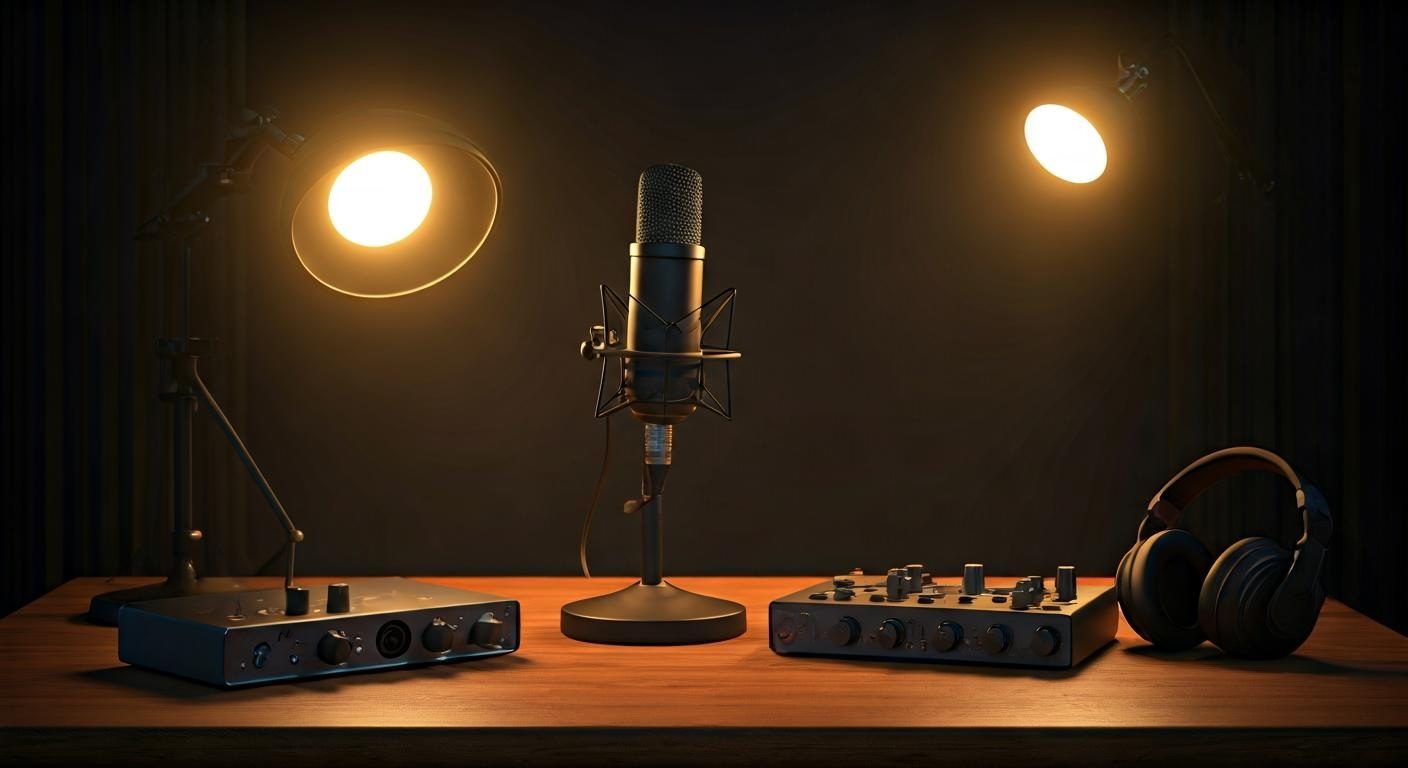
When we talk about an ambient microphone, we’re talking about air, depth, and realism. On a set as in documentary, the promise is simple : to recreate the sensation of being there. This comparison gathers models that I use or have put to the test, with concrete feedback and benchmarks to refine your sound capture.
Why ambient microphones are the signature of a credible mix
A shot without ambience sounds flat. The audience won’t forgive the absence of perspective, even if they can’t explain it. A good ambient microphone captures the breathing of a space: the room's reverberation, background movement, a contained crowd. It’s the sonic glue that binds voice, music, and sound effects.
In editing, these layers give a stable and natural stereo image. Without them, you stack isolated sources. With them, you tell a space. That’s where technical choices make all the difference.
Choosing according to the setting: studio, on set, outdoors
In studio: coherence and finesse
In the studio, I often opt for a matched pair of small-diaphragm microphones. We gain transient precision and tonal balance. For room ambiences, a pair of cardioids in ORTF gives a wide scene, without excess low-mid.
A pair of omnidirectional mics remains formidable in a good room: no proximity effect, an ample texture, and a lot of naturalness.
On TV set: control and repeatability
On set, the directivity must limit feedback and nuisances without sacrificing air. A fixed X/Y pair above the cameras provides a stable image, easy to recalibrate between takes. Decor variations require a reproducible method.
Supercardioid capsules are useful when the set is noisy. We protect ourselves better from off-axis unwanted sources while still retaining some of the pickup field.
Outdoor and documentary: mobility and ruggedness
Outside, everything moves: weather, unforeseen sources, distances. I favor compact stereo units mounted on a boom or camera, protected by a quality windscreen. In the forest, an omni pair reveals a sumptuous 'murmur'. In the city, a tightened X/Y stereo avoids mush.
For street sports or a market, an MS (Mid/Side) microphone lets you open or close the scene in editing. Great flexibility when the environment is changing.
The technical criteria that really make the difference
Capture field: width, angle, coherence
The chosen stereo pattern determines the width and localization of sources. A coincident stereo offers mono-compatible precision, while more generous spacings give breadth at the cost of potential phase issues.
Before buying, consult a guide to directivity. This factor conditions the rendering more than the name on the box.
Noise floor and useful dynamic range
The self-noise of a microphone determines the finesse of ambience captured at low levels. In a park at night, an electronic hiss quickly becomes overwhelming. Premium capsules close the gap on these sensitive scenes.
Sensitivity and headroom do the rest. A clean signal, well above the background noise, passes through the mix without aggressive compression.
Power, connectors and compatibility
Most serious ambient microphones require a 48 V phantom power via XLR. Camcorder models with mini-jack are convenient but limited in dynamic. Check the declared frequency response and compatibility with your recorders.
A condenser capsule remains the standard for ambience: high sensitivity, detail, and fast transients. Dynamics are only relevant for contexts that are very noisy or for particular effects.
Comparative 2026: models we recommend
Here's a proven selection covering several approaches to ambience. The noted uses reflect my tests and recent shoots.
| Model | Type / Pattern | Key strengths | Ideal for |
|---|---|---|---|
| RØDE NT4 | Coincident X/Y stereo | Plug-and-play, phase coherent, neutral color | News, room capture, urban ambiences |
| Audio‑Technica AT8022 | Compact X/Y stereo | Light format, camera mounting, good localization | News, mobile documentary, demanding travel vlogging |
| Neumann KM 184 (pair) | Cardioid pair | Definition, lively transients, standard studio | Room ambiences, orchestras, air-room Foley |
| Sennheiser MKH 8020 (pair) | Omni pair | Exemplary silence, sumptuous width | Nature, room tone, atmospheric effects |
| Sony ECM‑MS2 | MS stereo on camera | Versatility, Mid/Side decodable | Event coverage, ambience interviews, TV doc |
Autres pistes selon les besoins : DPA 4060 en A/B discret pour des paysages sonores cinématographiques, RØDE NTG3 pour compléter à distance quand on souhaite isoler une source au milieu d’un fond riche.
Stereo in practice: X/Y, ORTF, A/B, MS… what result to expect
The X/Y pair concentrates the scene, ensures excellent mono-compatibility, and limits phase issues. Practical in urban environments or on set.
The ORTF setup opens up stereo with realism that closely mirrors human hearing. Ideal for living interiors, concerts, and controlled crowds.
The A/B omni creates majestic width and natural low end. Requires a homogeneous and calm setting. The MS provides post-production control: you can adjust the amount without returning to the field.
Field feedback: three concrete cases
Neighborhood football match
Objective: capture the energy of the crowd without smothering the commentary. Solution: X/Y on a high boom, slightly toward the stands, and a narrower mic toward the touchline. Result: the stadium's breath comes through, the crowd's shouts remain readable, and the ball stays audible.
Dawn in the forest
Objective: birds, light wind, depth. Solution: spaced omni pair, high-end wind covers, recorder with very low background noise. We avoid movement: every step is audible. In the mix, a touch of low-end equalization to clean distant rumbles.
Talk-show with audience
Objective: laughs and reactions, without excessive leakage into the vocal mics. Solution: cardioids in ORTF above the seats, at a moderate level. We capture clean, measured reactions, easy to dial in on the 'public' track.
Accessories that make all the difference
- windjammer of quality: an investment that saves entire days of filming.
- Rycote suspension or equivalent: handling noises disappear, the low end cleans up.
- Carbon boom pole: reduced fatigue, smoother movements.
- Triggers and position markers: placing a pair within 2 cm avoids phase surprises.
Essential settings for a controlled texture
I set the peaks around −12 dBFS, with a soft limiter as a safety. A gentle equalization removes what masks: a bit of bass in urban outdoor, a bit of harsh highs in lively rooms.
Check the SPL level admissible to avoid saturation from fireworks, drums, engines. A clean preamplifier, placed as close as possible to the microphone, makes the difference when you push the gain.
Common mistakes to avoid
- Placing too low: you pick up footsteps, bags rubbing, and parasitic conversations.
- Neglecting coherence: an X/Y too wide + an AB too far apart in the same scene = unstable image.
- Everything set by sight: listening with closed-back headphones remains your best judge.
- Ignoring the environment: fridge, neon lights, ventilation, distant road noises… it all ends up on the track.
Budget: from agile kit to evolving pro setup
Entry-level option
A compact stereo such as AT8022 or Sony ECM‑MS2, a quality windscreen, a lightweight boom. Ideal for light documentary and web video with reliable rendering.
Versatile mid-range
A RØDE NT4 or a matched pair cardioids, suspension, full wind protection, silent 24-bit/96 kHz recorder. Perfect for TV reports and ambitious podcasts.
Audiophile-grade high-end
Neumann or Sennheiser MKH pair, dedicated MS setup, premium accessories. For cinema recordings, nature and music where every detail matters.
Ambient microphone: checklist before hitting REC
- Placement: height, angle, distance from dominant sources.
- Chosen stereo pattern depending on the set and mobility.
- Levels: safety margin, headphone monitoring, saturation test.
- Protection: wind, light rain, cable noises, rubbing.
- Plan B: a second listening point or standby room tone take.
Resources to deepen and progress
To understand in detail the families of polar diagrams, this complete guide to directivity helps you make choices consistent with your sets.
Most ambiences rely on condenser transducers. This guide on the condenser microphone clarifies the issues of sensitivity, noise and materials, useful to refine your selection.
My field verdict
For a compact and quick setup, the RØDE NT4 remains a versatile ally. For a cinema approach, a pair of MKH omnis opens up a world of space. The KM 184 cardioids serve as a Swiss Army knife in the studio as well as in live capture.
Beyond the model, it’s the method that pays: attentive listening, patient placement, careful protection. When everything aligns, the magic happens and the space tells its story effortlessly.