
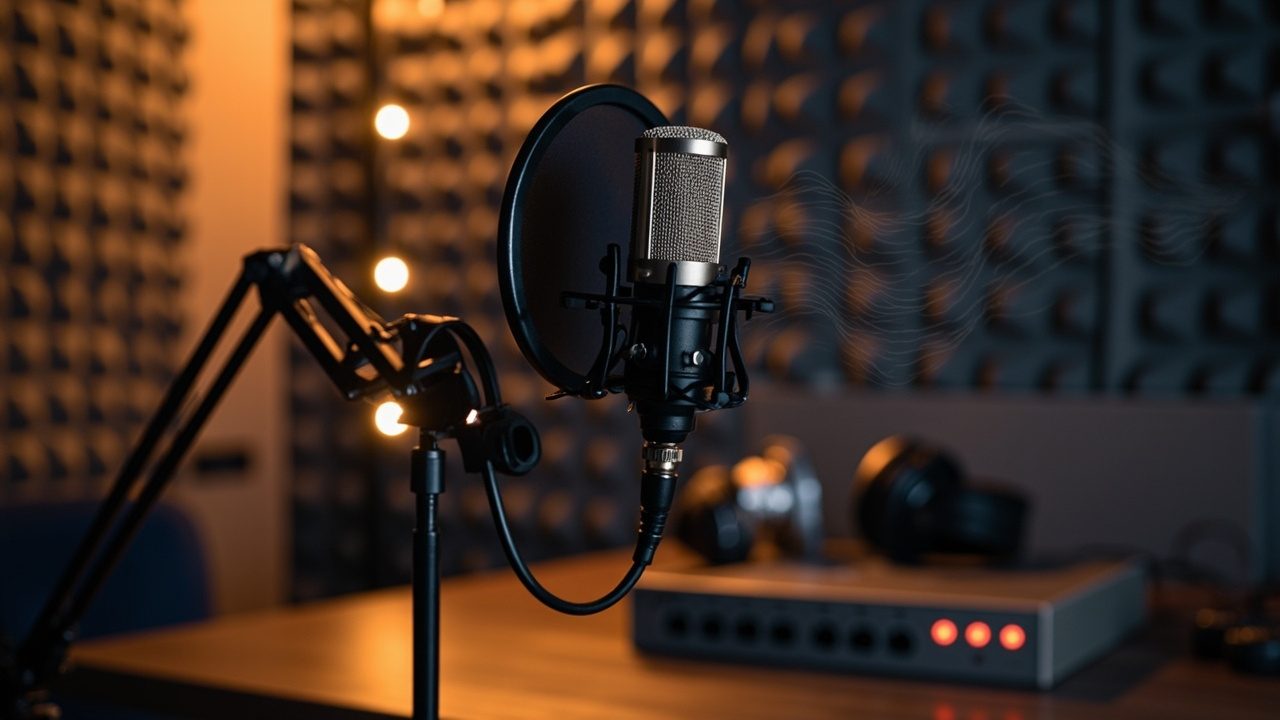
A microphone that resonates spoils a take, undermines a direct feed and tires the listener. Behind this portmanteau, there are three realities: room echo, buzzing from furniture resonance, and Larsen sibilance. I come from the audiovisual field and I’ve learned to fix these situations on the fly, whether in a voice studio, on a set or in a living room transformed into a booth. Below you’ll find concrete methods to understand, diagnose and correct this phenomenon without wasting a day of shooting.
Pourquoi votre micro « résonne » : les vraies raisons
The term primarily covers the reverberation of the room. Bare walls, tiles and glass reflect your voice, which overlaps the direct signal. We’re talking about a decay time (RT60) that is too long, typical of untreated rooms.
Another case: a low frequency that swells on certain notes. It’s the room that vibrates at specific frequencies. A shelf, a hollow desk or a corner of a wall acts as a resonant box.
Finally, the unbearable whine of the Larsen. It’s a loop between microphone, amplification and speakers. As soon as the gain exceeds the stability threshold, the leaking frequency explodes.
Diagnostiquer le phénomène en conditions réelles
Le test de claque et la phrase témoin
I start with a short clap in the room. If the return sounds like a bright tail, the room is too live. I then read a sentence with lots of “p”, “b” and “s”. The boomy lows indicate a modal bump, the aggressive “s” point to an over‑excited high mid.
Isoler le maillon fautif
- Closed-back headphones, monitoring turned off in the software. If the whine disappears, the loop comes from the return.
- Microphone held in the hand, you move about a meter in every direction. If the bass changes abruptly, the room is at fault.
- You lightly touch the furniture. If a hum stops when you press on the desk, it resonates.
Réglages matériels: placement, polarité et gain
Choisir la bonne captation
The direction of capture directly influences reflections. A cardioid pickup pattern microphone reduces side and rear ambience. To understand the impact of lobes and dead zones, a clear refresher on the microphone directivity will save you valuable time.
Distance et angle
Hold 10–15 cm from a dynamic capsule with a pop filter, 15–25 cm for a condenser, with a slight off‑axis angle to soften the sibilants. Too close, the bass swells due to the proximity effect. Too far, the room takes over.
Gain propre et marge de sécurité
Set the gain to target peaks around −12 dBFS in the DAW. Avoid compensating a distant mic by cranking a preamp to the max. A proper audio interface and a well‑placed capsule are worth more than a heroic compressor. This is the ABCs of gain staging.
Éviter les doubles écoutes
On a computer, keep only one monitoring path active. Cut software monitoring if you use the interface’s direct monitoring, or the reverse. Latency mismatches create doubles and worsen the monitoring.
Traiter la pièce: du bricolage malin aux solutions pro
Absorber là où ça compte
Place absorbing materials where the voice bounces first: behind the microphone, to the sides, directly above on the ceiling. A thick blanket, a heavy curtain, a dense rug already make an audible difference.
Coin voix rapide et efficace
- Two clothing racks and two duvets forming an L‑shape.
- A mattress against the wall behind you.
- A cardboard box filled with clothes placed near the source.
For spoken voices, aim for an RT60 of 0.2–0.4 s to achieve clear diction without a cold clinical feel. Thin decorative foams do not treat the low‑mid. To calm 120–250 Hz, prefer thick mineral wool or broad‑band panels.
Corriger à la source dans le logiciel
Filtrer et sculpter
Activate a high‑pass filter between 70 and 100 Hz for a male voice, 90 to 140 Hz for a female voice, depending on timbre. A light equalization with a parametric EQ lets you sweep and attenuate a modal bump with narrow bands (high Q) between 120 and 300 Hz.
Nettoyer avec parcimonie
A soft noise gate can reduce the ambience tail between phrases, provided you set the threshold low and the opening times natural. In post, modern de‑reverb plugins save difficult takes, but it’s better to address the cause than the consequence.
Réglages système à vérifier
- Disable the “Listen to this device” option on Windows.
- In Zoom/Meet, do not combine echo cancellation with hardware monitoring.
- Work at 48 kHz for video, 24 bits to keep margin without clipping.
Prévenir le Larsen en live et sur scène
Placement face aux enceintes
Angle the rear of the mic toward the stage monitors to exploit the dead angle. Avoid mirror axes between the capsule and the loudspeakers. A quiet stage is won through preparation, not desperate corrective measures.
Égalisation anti‑larsen
Raise the gain gradually with the singer’s voice, not with pink noise. As soon as a frequency starts to rise, cut it narrowly on the return bus, never excessively. An EQ of 3 to 6 dB is often enough.
Le bon type de micro
On noisy stages and reverberant venues, a tight dynamic mic limits the ambience. To understand when to prefer a rugged or a sensitive capsule, this guide on dynamic or condenser microphone will help you choose the right tool.
Méthode express: 15 minutes pour sauver une prise
- Mute all audible monitoring paths. Keep only one monitoring path.
- Move the mic closer to 12–15 cm, place it slightly off axis, add a pop filter.
- Place a duvet behind the speaker and a rug under the feet.
- Put a bag or a blanket on the hollow desk that vibrates.
- Activate the high‑pass filter and cut 2–3 dB at 180–250 Hz if the bass masks.
- Set the gain for peaks at −12 dBFS, compress lightly (3:1, medium attack).
- If the ambience persists, a touch of de‑reverb in post, without excess.
Checklist et erreurs fréquentes
| Symptom | Probable cause | Quick fix |
|---|---|---|
| Sudden whistling | Mic/returns loop | Mute one of the returns, orient the back of the mic toward the speaker |
| Boomey bass | Room mode, hollow desk | Move away from the wall, mass the surface, narrow EQ at 120–250 Hz |
| Strong echo | Room too lively | Blankets, heavy curtains, reduce the distance mouth‑to‑mic |
| Voice doubling | Two monitorings overlapped | Keep only one return, disable software or hardware monitoring |
| Aggressive sibilants | Capsule too on‑axis | Off‑axis angle, light de‑essing, add 2–3 cm distance |
Cas concrets tirés du terrain
Podcast dans un salon carrelé
Two voices, a sofa and a plasterboard wall. We built an L of duvets, laid a rug and brought the mics closer. The decay time dropped, diction became readable. A quick parametric EQ at 180 Hz removed the remaining heaviness.
Interview en open‑space
Rather than fighting the hubbub, a close dynamic capsule and low gain. A door propped open served as an improvised absorber. Monitoring was limited to a headset for the taker.
Live acoustique en petite salle
The guitar was boosting the room’s bass. We moved the performer 60 cm closer, rotated the returns, placed a blanket under the mic stand. End of the boom, no need to notch 10 dB in the lows.
Aller plus loin pour un son maîtrisé
Once the base is stabilized, fine‑tune with a transparent compressor, a light harmonic saturation and a prudent de‑esser. Software corrections do not replace good acoustic treatment, but they finish the job neatly.
If the topic fascinates you and you like testing configurations, studying polar diagrams and microphone capsule families via the page cited on microphone directivity will complete the technical move.
Récapitulatif opérationnel
- Bring closer, orient off axis, stabilize the gain.
- Calm the room with simple targeted solutions.
- Filter the lows with a high‑pass filter, correct with a parametric EQ.
- Avoid double returns, monitor echo cancellation in software.
- Address the Larsen at the source with placement and fine cuts.
A resonant microphone is not a fatality. With good reflexes and a few accessories, you take back control. To choose your capsule wisely depending on the set and the voice style, take a look at the comparison between dynamic and condenser mentioned above. Your voice deserves a clean, clear, controlled frame.